The Revolutionary Moment That Changed Television Forever
On January 12, 1971, American television was about to experience a seismic shift that would reshape entertainment forever. When “All in the Family” premiered on CBS, nobody knew whether viewers would embrace or reject this groundbreaking experiment. The network was so nervous about potential backlash that they hired extra telephone operators to handle what they anticipated would be a flood of angry complaints. What happened instead became one of the most remarkable success stories in television history.
Breaking the Unspoken Rules of American Television
Before “All in the Family,” television sitcoms existed in a sanitized bubble where real-world problems rarely intruded. Families were perfect, conflicts were trivial, and anything remotely controversial was carefully avoided. Television legend Norman Lear, serving as executive producer alongside Bud Yorkin, decided to shatter these timid conventions with a revolutionary approach: showing American families as they actually were, complete with all their messy, complicated, and uncomfortable truths.
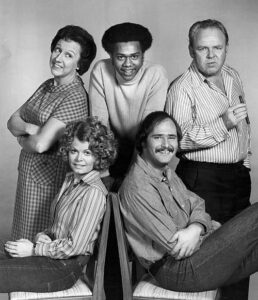
The setting itself was deceptively simple: a modest working-class home in Queens, New York, belonging to the Bunker family. But within those walls, Lear unleashed conversations about racial prejudice, sexism, the Vietnam War, sexual orientation, rape, cancer, and every other hot-button issue that polite television had carefully avoided. In one memorable moment that shocked audiences, the show even featured the sound of a toilet flushing, something that had never been heard in a sitcom before. Archie Bunker called it a “turlet,” and that simple bathroom humor represented something much bigger: television was finally acknowledging that real life existed.
The Unforgettable Characters Who Became America’s Family
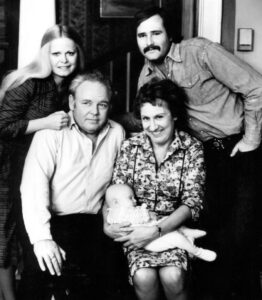
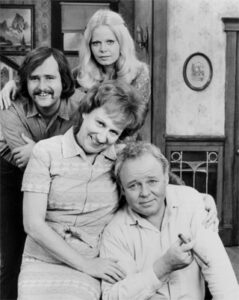
The brilliance of “All in the Family” rested on its extraordinary cast, who brought depth and humanity to characters that could have easily become one-dimensional caricatures. Carroll O’Connor portrayed Archie Bunker, a bigoted, working-class man terrified of the social changes swirling around him in 1970s America. But here’s what made the show genius: Archie wasn’t presented as a villain. He was flawed, ignorant, and often wrong, yet he possessed moments of vulnerability and even the possibility of redemption. Audiences saw their own fathers, uncles, and neighbors in Archie, which made his journey all the more powerful.
Jean Stapleton created an unforgettable Edith Bunker, Archie’s wife, who initially appeared simple and subservient but gradually revealed herself to be the wisest person in the room. Her gentle strength provided the moral compass of the show, offering viewers a masterclass in how kindness and patience can challenge prejudice more effectively than confrontation.
The show’s younger generation, daughter Gloria played by Sally Struthers and son-in-law Mike portrayed by Rob Reiner, served as Archie’s liberal foils. Mike, whom Archie dismissively called “Meathead,” represented the progressive values of younger Americans, creating explosive dinner table arguments that mirrored conversations happening in millions of homes across the country.
Cultural Impact That Resonates Five Decades Later
The numbers tell part of the story: “All in the Family” dominated television ratings as the number one show for five consecutive seasons and collected an impressive 22 Emmy Awards. But statistics don’t capture the show’s true cultural impact. This was television that made America argue, think, and occasionally change their minds.
Sally Struthers recalled in a 2009 interview how uncertain everyone felt before the premiere, not knowing whether audiences would accept such controversial content. Norman Lear remembered receiving mail “by the tens of thousands” throughout the show’s run. What struck him most wasn’t whether people agreed or disagreed with Archie’s views, but what they all shared: “My father, my mother, my sister, my family – we argued about this, that and the other thing.” Lear recognized this as democracy in action, families engaged in crucial conversations about the issues defining their era.
Carroll O’Connor explained the show’s philosophy in a 1991 interview: “We would go after the most controversial topic of the day. That was our stock in trade – to make trouble.” While other early 1970s shows retreated from sensitive subjects, “All in the Family” ran straight toward them, trusting audiences to handle complex, uncomfortable topics with intelligence and nuance.
A Legacy That Spawned Television Dynasties
“All in the Family,” inspired by the British sitcom “Till Death Us Do Part,” created television’s most impressive collection of spinoff series. “The Jeffersons” followed the Bunkers’ African American neighbors as they moved to Manhattan’s Upper East Side, becoming one of the longest-running sitcoms with a predominantly Black cast. “Maude” featured Edith’s liberal cousin confronting issues like abortion and depression. “Good Times” explored the struggles and triumphs of a Black family in a Chicago housing project. Each spinoff continued Lear’s mission of addressing real social issues through the sitcom format.
The show’s eight-season run from 1971 to 1979 left an indelible mark on American television. Its memorable theme song, “Those Were the Days,” captured Archie’s nostalgia for an imagined idyllic past, a sentiment that continues to resonate in contemporary cultural debates.
Proving Timeless Relevance in the Modern Era
For years, television critics and cultural commentators debated whether “All in the Family” could work in today’s polarized media environment. In 2019, Norman Lear and ABC late-night host Jimmy Kimmel definitively answered that question by producing a live, Emmy-winning reproduction of an original script featuring an A-list cast. The special earned high ratings, proving that honest, challenging television about difficult subjects still commands audience attention and respect.
Fifty years after its premiere, “All in the Family” remains a testament to the power of television to spark conversation, challenge assumptions, and bring families together even through disagreement. The show’s legacy reminds us that great entertainment doesn’t shy away from controversy – it embraces complexity, trusts audiences with difficult subjects, and recognizes that sometimes the best way to address serious issues is through the healing power of laughter.