The Man Behind the Bigot: Norman Lear’s Most Personal Creation
They say you should write what you know, and Norman Lear took that advice to heart in the most unexpected way imaginable. When he created Archie Bunker, the lovable bigot who became one of television’s most memorable characters, Lear didn’t just adapt a British sitcom character. He reached deep into his own childhood, pulled out his most complicated relationship, and transformed his father—flaws, frustrations, and all—into television gold.
Most people know that “All in the Family” was based on the British sitcom “Till Death Us Do Part,” but what they don’t realize is that the American version became something far more personal, far more intimate, and infinitely more complex because Norman Lear infused Archie Bunker with the DNA of Herman K. Lear—the flamboyant, exasperating, unforgettable man Lear called “H.K.” or simply “Dad.”
A Complicated Love Story Written in Television Scripts
In his revealing autobiography “Even This I Get to Experience,” Norman Lear opened up about the relationship that shaped not just Archie Bunker, but his entire creative philosophy. His relationship with his father was messy, painful, and filled with the kind of contradictions that make for compelling drama. Yet despite all the hurt, despite all the disappointments, Lear confessed something that explains everything about why Archie Bunker resonated with millions of Americans: “Despite all the hurts and disappointments, how I loved my father.”
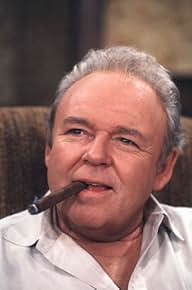
That love manifested in the most creative way possible. Lear wrote, “I wrote love letters to him all my life, many of them in ‘All in the Family,’ in which Archie has so many of my father’s characteristics.” Think about that for a moment. Every episode featuring Archie Bunker wasn’t just entertainment—it was Norman Lear processing his relationship with his father in front of millions of viewers. The nation laughed at Archie’s antics while Lear worked through decades of complicated emotions disguised as situation comedy.
The Bicarbonate of Soda Scene That Came From Real Life
Some of the most memorable Archie Bunker moments came directly from H.K. Lear’s actual behavior, transplanted from Norman’s childhood living room to the Bunker household in Queens. One particular scene captures this perfectly, and once you know its origin, you’ll never watch it the same way.
Lear recalled how his father constantly relied on bicarbonate of soda for heartburn, a habit he gave directly to Archie. In one classic “All in the Family” episode, when Edith brought Archie the bicarb he’d shouted for, Mike Stivic—ever the provocateur—decided to point out the predictability: “Look at him, he’s a robot. He swallows the potion, and exactly fourteen seconds later”—dramatic finger snap—”the heartburn’s gone.”
What happened next was pure television magic rooted in Norman Lear’s real childhood memories. Archie drank and fumed while Mike enthusiastically counted the seconds in his face, building tension with each number. Then, right on cue at fourteen seconds exactly, “much to his relief and chagrin, a long, mellifluous belch erupted out of Archie.” Millions laughed at that perfectly timed burp, never knowing they were watching Norman Lear’s actual father, immortalized in prime time.
“Stifle!”: The One Word That Defined Two Generations
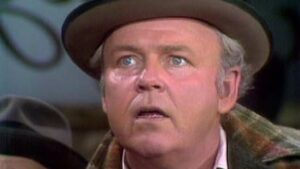
If you’ve watched even a handful of “All in the Family” episodes, you’ve heard Archie tell Edith to “Stifle!” It became one of television’s most quoted catchphrases, instantly recognizable and perfectly capturing Archie’s frustrated attempts to control his household. But that wasn’t the creation of a writers’ room brainstorming session—it was Norman Lear’s mother, Jeanette, being silenced by his father.
Lear’s description of the original moment is almost cinematic in its intensity: “‘Jeanette!’ he screamed, the veins in his neck bulging as he stood over her with his nose all but pressing hers. ‘Stifle!’ And off he went.” That single word, delivered with such physical intensity that young Norman could see his father’s neck veins bulging, became shorthand for an entire dynamic. Decades later, when Carroll O’Connor delivered the same line to Jean Stapleton, America laughed—but Norman Lear was processing childhood trauma disguised as comedy.
The genius of this transformation is how Lear took something that must have been frightening or at least uncomfortable for a child to witness and turned it into something that revealed character, created comedy, and commented on marital dynamics in working-class America. That’s alchemy—turning personal pain into universal entertainment.
The Throne That Launched a Thousand Arguments
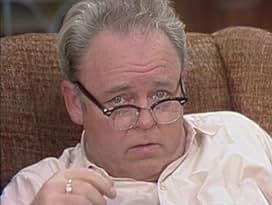
Even Archie’s famous armchair—the throne from which he controlled the Bunker family’s television viewing, the sacred space no one else dared occupy—came directly from Norman Lear’s childhood. He recalled a moment that must have crystallized his complicated feelings about his father and that chair: “At one point, someone I didn’t know (but instantly disliked) offered to buy my father’s red leather chair—the throne from which he had controlled the radio dial on our floor model Atwater Kent.”
Note the language Lear used: “throne” and “controlled.” That chair represented power, patriarchal authority, and the ability to dictate what the entire family would listen to or watch. When someone offered to buy it—someone young Norman instantly disliked—he was watching an outsider try to purchase a symbol of his father’s dominance. Forty years later, that red leather chair became Archie’s shabby armchair, and the radio dial became a television remote, but the meaning remained exactly the same.
The H.K. Gene: A Father’s Legacy Across Multiple Characters
Perhaps most tellingly, Norman Lear eventually recognized that his father’s influence extended far beyond just Archie Bunker. In his autobiography, he wrote about what he called “the H.K. gene”—the genetic material his father contributed not just to Archie, but to multiple characters across his television universe.
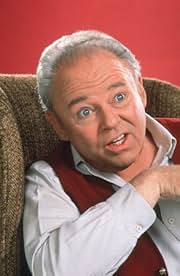
“If H.K. was a marvel of sorts, so were Archie Bunker, George Jefferson, and Maude Findlay, among others,” Lear explained. “They were all entertaining marvels, examples of what I now think of as the H.K. gene.” Think about what that means: the flamboyant quality, the strong opinions delivered with absolute conviction, the ability to dominate a room, the complexity that made you love them despite their flaws—all of that came from Herman K. Lear.
Why This Revelation Matters
Understanding that Archie Bunker was based on Norman Lear’s actual father transforms how we understand both the character and the show. Archie wasn’t just a caricature of working-class prejudice—he was a fully realized human being because he was based on one. The reason Archie could be bigoted yet lovable, infuriating yet vulnerable, wrong about so much yet occasionally touching in his limited way, was because Norman Lear understood that complexity intimately. He’d lived with it, struggled with it, and ultimately found a way to love it.
“All in the Family” succeeded where so many social commentary sitcoms failed because at its heart was this deeply personal relationship transformed into universal storytelling. Norman Lear turned his complicated father into America’s complicated father, and in doing so, he created something that transcended entertainment to become a cultural mirror.
Every “Stifle!” was a love letter. Every belch was a memory. Every moment in that armchair was Norman Lear working through what it meant to love someone who frustrated him endlessly. And somehow, that personal emotional journey became television history.