Television lost one of its greatest visionaries when Norman Lear passed away on December 5, 2023, at the age of 101. But on Monday night at the 2023 Emmy Awards—delayed for months due to the WGA and SAG-AFTRA strikes—the industry came together to celebrate the life of a man who didn’t just create entertainment, but fundamentally transformed American culture. The most poignant moment of the evening came when the cast of All in the Family reunited to honor their creator, delivering a tribute that reminded everyone why Lear’s work mattered then and continues to resonate now.
A Family Reunion on the Emmys Stage
Rob Reiner and Sally Struthers, forever known as Michael and Gloria Bunker to millions of viewers, stepped onto a stage carefully designed to recreate the iconic Bunker household. The set alone was enough to transport viewers back to 704 Hauser Street in Queens, where American television was forever changed. But it was what Reiner and Struthers said—and how they said it—that made this tribute unforgettable.
“Sally and I were part of a unique television family: not just the Bunkers, but Norman Lear’s extended family,” Reiner began, his voice carrying the weight of decades of gratitude and loss. This simple statement captured something profound about Lear’s approach to television production. He didn’t just hire actors—he built families. The bonds created on his sets weren’t merely professional; they were deeply personal connections that lasted lifetimes.
Reiner continued by emphasizing what set Lear apart from other producers. His groundbreaking shows didn’t just entertain; they challenged audiences to think critically and feel deeply about issues that mattered. At a time when most sitcoms avoided controversy, Lear ran toward it, tackling subjects that other producers wouldn’t dare touch.
The Yiddish Word That Explained a Genius
Then Reiner introduced a concept that perfectly encapsulated Lear’s approach to television and culture: “kochleffel.” For those unfamiliar with Yiddish, he explained that a kochleffel is a ladle—a stirring spoon used to agitate the contents of a pot, ensuring nothing settles or stagnates.
“When Norman the kochleffel stirred that pot, he wound up changing American culture,” Reiner said.
This metaphor is brilliant in its simplicity and accuracy. Lear didn’t let America sit comfortably with its prejudices, its silence on difficult topics, or its sanitized version of family life. He stirred the pot constantly, forcing viewers to confront uncomfortable truths about racism, sexism, homophobia, economic inequality, and generational divides. He made people laugh while simultaneously making them think—and sometimes making them squirm.
The image of Lear as a kochleffel perfectly captures his genius: he agitated, provoked, challenged, and ultimately transformed the cultural conversation in America. He refused to let audiences—or the television industry—remain stagnant.
Celebrating Legends and Their Legacy
Sally Struthers added her own heartfelt words to the tribute, acknowledging not just Lear but all the legends of the television industry who had passed away in the previous year. “Tonight, as we remember the legends of our industry, we celebrate their lives and legacy and the joy they brought to us,” she said, her voice carrying both sorrow and celebration.
Then, in a moment that brought many viewers to tears, Reiner and Struthers concluded together with three simple words that instantly transported everyone back to the opening credits of All in the Family: “Those were the days.”
Those four syllables carried immense weight—nostalgia, yes, but also recognition that what Lear created was lightning in a bottle, a perfect storm of talent, timing, and fearless storytelling that changed television forever.
The Show That Dared to Be Different
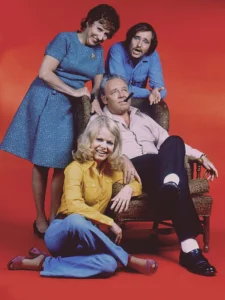
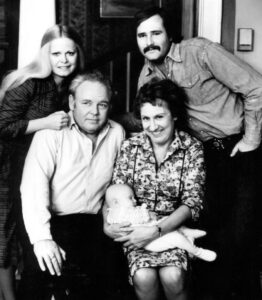
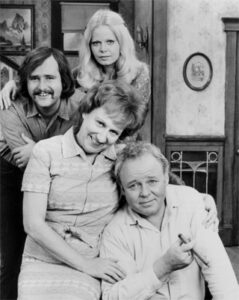
All in the Family, based on the British sitcom Till Death Do Us Part, centered on the Bunker family and the explosive generational clashes between the bigoted patriarch Archie Bunker, played by the late Carroll O’Connor, and his liberal son-in-law Michael, nicknamed “Meathead.” The show was revolutionary for its willingness to tackle taboo subjects that other sitcoms wouldn’t touch: abortion, the Vietnam War, racial stereotypes, rape, homosexuality, women’s liberation, and countless other topics that made network executives nervous.
What made the show genius wasn’t just its willingness to address these issues—it was Lear’s understanding that you could make people laugh while making them think. Archie Bunker was simultaneously hilarious and horrifying, a character audiences could laugh at while recognizing uncomfortable truths about American prejudice. The show didn’t preach; it presented different perspectives and let audiences draw their own conclusions, though Lear’s own liberal values were never in doubt.
Over its nine-season run from 1971 to 1979, All in the Family dominated both ratings and critical acclaim, winning three Emmy Awards for Best Comedy Series. Its cultural impact extended beyond the original series through successful spinoffs including Maude, The Jeffersons, and Archie Bunker’s Place—each continuing Lear’s tradition of using comedy to explore serious social issues.
“Am I Not the Luckiest Dude?”
Following Lear’s passing, his family released a statement that beautifully captured his approach to life. “He often said, ‘Am I not the luckiest dude?’ He was grateful for everything that brought him to the moment he was in.”
This gratitude and presence defined Lear’s long life. He lived to 101, remaining creatively active and engaged until the end. His family expressed their own profound gratitude: “Knowing and loving him has been the greatest of gifts.”
That sentiment was echoed by the countless actors, writers, producers, and crew members who worked with Lear over his seven-decade career. He didn’t just create television shows—he created families, launched careers, and gave voice to perspectives that had been marginalized or ignored by mainstream media.
A Legacy That Continues to Stir the Pot
The 2023 Emmys tribute to Norman Lear, broadcast live from the Peacock Theater in Los Angeles, was more than just a memorial. It was a reminder of what television can be when creators are willing to take risks, when they trust audiences to handle complexity and nuance, when they use the medium not just to entertain but to challenge, provoke, and ultimately enlighten.
Norman Lear the kochleffel stirred America’s cultural pot for decades, and the ripples from his work continue today. Every time a television show tackles a difficult subject, every time a sitcom makes you laugh and think simultaneously, every time a producer chooses courage over caution—that’s Norman Lear’s legacy.
Those were the days, indeed. But the impact of those days continues to shape the present and will undoubtedly influence the future of television for generations to come.