Television Legend Norman Lear Defies Age and Expectations with Revolutionary Live Special
At ninety-six years old, most people are content with their legacy. Not Norman Lear. The television titan who revolutionized sitcoms in the 1970s just delivered a masterclass in why great storytelling never goes out of style. When ABC announced that legendary shows “All in the Family” and “The Jeffersons” would be performed live with an all-star cast, skeptics immediately questioned whether these controversial shows could resonate with modern audiences. Lear’s response? Watch us prove you wrong.
The Ambitious Vision Behind “Live in Front of a Studio Audience”
Partnering with late-night host Jimmy Kimmel, Norman Lear conceived something unprecedented in television history—a live recreation of classic sitcom episodes performed by Hollywood’s biggest stars. The concept was audacious: take shows that tackled racism, sexism, and class warfare in the 1970s, and present them to contemporary audiences without updating or sanitizing the content. It was either going to be brilliant or catastrophically tone-deaf. There was no middle ground.
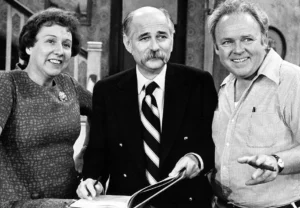
“People say ‘these two shows were meant for the ’70s and would not work today,'” Lear explained in a statement that carried the weight of decades of experience. “We disagree with them and are here to prove, with two great casts depicting ‘All in the Family’ and ‘The Jeffersons,’ the timelessness of human nature.” This wasn’t just nostalgia—it was a declaration that the issues these shows confronted remain unresolved, and the conversations they sparked are still desperately needed.
The ninety-minute special, titled “Live in Front of a Studio Audience: Norman Lear’s ‘All in the Family’ and ‘The Jeffersons,'” brought together an impressive roster of talent. Woody Harrelson and Marisa Tomei stepped into the iconic roles of Archie and Edith Bunker, originally immortalized by Carroll O’Connor and Jean Stapleton. Meanwhile, Jamie Foxx and Wanda Sykes took on George and Louise Jefferson, characters that Sherman Hemsley and Isabel Sanford made legendary during the original show’s decade-long run from 1975 to 1985.
Why These Particular Shows Still Matter
The choice of “All in the Family” and “The Jeffersons” wasn’t arbitrary—these shows represented seismic shifts in television’s willingness to engage with uncomfortable truths. When “All in the Family” debuted in 1971, it shattered every unwritten rule about what sitcoms could discuss. The show centered on the Bunkers, a working-class family in Queens, New York, led by Archie Bunker, an unapologetic bigot whose ignorance provided both comedy and cultural commentary.
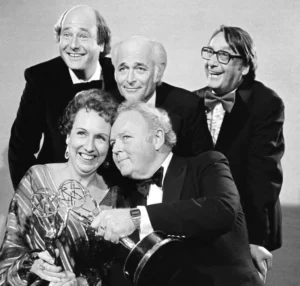
What made the show revolutionary wasn’t just that it featured a racist protagonist—it was how it used Archie’s character to expose the absurdity of prejudice. Audiences laughed at Archie, not with him, and in doing so, they were forced to confront their own biases. The show became a mirror reflecting America’s racial tensions, gender politics, and generational conflicts back to viewers who weren’t entirely comfortable with what they saw.
“The Jeffersons” emerged from this groundbreaking foundation four years later, presenting another first for television—a successful African American family navigating life in a predominantly white world. George and Louise Jefferson had “moved on up” to a deluxe apartment in Manhattan’s East Side, embodying the American Dream in a way that challenged racial stereotypes. The show also featured one of television’s first interracial couples, another barrier-breaking element that pushed boundaries in ways that feel both historic and frustratingly still relevant.
The All-Star Cast Stepping Into Legendary Roles
Casting this special required finding actors who could honor the original performances while bringing their own interpretation to these beloved characters. Woody Harrelson, known for his versatility and fearlessness in tackling controversial material, seemed perfectly suited to navigate Archie Bunker’s complex character—a man whose bigotry masked deeper insecurities and whose occasional moments of growth made him human rather than simply villainous.
Marisa Tomei’s Edith presented a different challenge. Jean Stapleton’s original portrayal was so iconic that her high-pitched voice and gentle demeanor became inseparable from the character. Tomei needed to capture Edith’s patience and wisdom without simply impersonating Stapleton’s performance—a delicate balance that required tremendous skill.
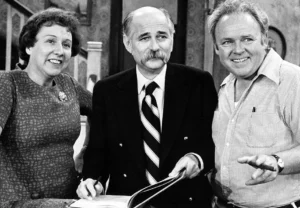
Jamie Foxx as George Jefferson brought his considerable comedic talents to a role that demanded both broad humor and subtle emotional depth. George Jefferson was brash, confident, and unapologetically ambitious—characteristics that could easily become caricature in less capable hands. Foxx’s ability to find humanity in larger-than-life characters made him an inspired choice.
Wanda Sykes as Louise Jefferson, affectionately known as “Weezy,” had the task of embodying a character who served as both George’s conscience and his anchor. Louise was sophisticated, patient, and possessed an inner strength that balanced George’s bombastic personality. Sykes brought her own sharp wit and warmth to a role that required both qualities in equal measure.
The special also featured Ellie Kemper, Justina Machado, and Will Ferrell in supporting roles, with additional stars announced as the production developed. Sitcom veteran James Burrows, whose directorial credits read like a history of television comedy excellence, directed the ninety-minute event. Ferrell, Lear, and Kimmel served as executive producers, ensuring the special maintained both respect for the original material and relevance for contemporary viewers.
Why Now? The Timelessness of Human Nature
Norman Lear’s statement about proving “the timelessness of human nature” cuts to the heart of why this special matters beyond nostalgia. The issues “All in the Family” and “The Jeffersons” tackled—racism, economic inequality, women’s rights, interracial relationships—haven’t been resolved in the nearly fifty years since these shows premiered. If anything, many of these conversations have become more urgent and divisive.
The special forced audiences to confront an uncomfortable truth: we’re still having the same arguments, still struggling with the same prejudices, still navigating the same social tensions that Lear dramatized decades ago. The fact that these episodes could air in 2019 without feeling like museum pieces speaks both to their brilliance and to our failure to adequately address the issues they raised.

“All in the Family” was a groundbreaker when it debuted, using comedy as a vehicle to explore racism, women’s rights, and other hot-button issues that most shows avoided entirely. “The Jeffersons” continued that tradition, presenting African American success as normal rather than exceptional, and featuring an interracial couple—Tom and Helen Willis—when such relationships were still illegal in some states within living memory.
Lear’s Continued Commitment to Relevance
At ninety-six, Norman Lear remained as committed to pushing boundaries as he was in his forties. Prior to this special, he served as executive producer on a Netflix reboot of another of his classic series, “One Day at a Time,” which originally ran from 1975 to 1984. The reboot reimagined the show with a Latino family, updating the setting while maintaining Lear’s signature approach of using comedy to explore serious issues. Though Netflix eventually canceled the series, it demonstrated Lear’s belief that the formula he pioneered—smart comedy that respects audiences’ intelligence and willingness to engage with complexity—remains viable.
This live special represented more than a victory lap for a legendary producer. It was a statement of purpose, a reminder that television can be both entertaining and important, that comedy can challenge rather than simply comfort, and that the best stories transcend their original context because they speak to fundamental human experiences.
Norman Lear didn’t just create classic television—he created a template for how entertainment can spark necessary conversations, challenge comfortable assumptions, and make us laugh while making us think. At ninety-six, he proved that his vision hasn’t become outdated; society simply hasn’t caught up yet.