The Revolutionary Blueprint That Changed Television Forever
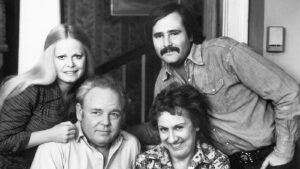
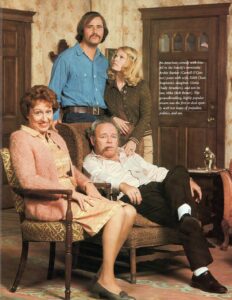
When “All in the Family” premiered on CBS in January 1971, nobody could have predicted it would become the Big Bang of television spin-offs. Norman Lear’s audacious sitcom about the Bunker family—led by the unforgettable bigot Archie Bunker, brilliantly portrayed by Carroll O’Connor—didn’t just push boundaries. It obliterated them completely, creating a television landscape where social issues weren’t just acknowledged but placed center stage with uncomfortable honesty and surprising humor.
The show’s DNA proved so potent that it spawned an unprecedented seven spin-offs, each carrying forward Lear’s revolutionary vision of using comedy as a vehicle for social commentary. This wasn’t just successful television—this was a cultural movement disguised as entertainment. Let’s dive deep into this extraordinary family tree of groundbreaking television that continues to influence what we watch today.
Maude: The Fearless Trailblazer That Started It All
The first branch on the “All in the Family” tree grew in 1972 when Edith Bunker’s outspoken liberal cousin Maude Findlay stepped into her own spotlight. Played with fierce brilliance by Bea Arthur, “Maude” represented everything Archie Bunker despised—and everything 1970s America needed to confront. This wasn’t your grandmother’s sitcom about a middle-aged woman. This was television with teeth.
“Maude” tackled abortion in 1972—yes, you read that correctly—an entire year before Roe v. Wade. The two-part episode “Maude’s Dilemma” generated more controversy than most shows experience in their entire run, yet it demonstrated exactly what made the Lear universe so vital. The show ran for six seasons, proving that audiences were hungry for comedy that respected their intelligence and didn’t shy away from complexity. Bea Arthur’s razor-sharp delivery and the show’s willingness to discuss feminism, mental health, and political hypocrisy made it essential viewing and established the template for every socially conscious sitcom that followed.
The Jeffersons: Moving On Up to Television History
If “Maude” was revolutionary, “The Jeffersons” was downright historic. Premiering in 1975 and running for an incredible eleven seasons until 1985, this spin-off followed George and Louise “Weezy” Jefferson as they traded their Queens neighborhood (where they’d been Archie’s neighbors) for a luxury Manhattan high-rise. The premise itself was groundbreaking: an African American family achieving the American Dream on their own terms, running a successful dry-cleaning business, and living in the kind of apartment most viewers could only fantasize about.
Sherman Hemsley and Isabel Sanford created television magic as George and Weezy, delivering performances that balanced comedy with genuine emotional depth. The show’s theme song, “Movin’ On Up,” became more than just a catchy tune—it became an anthem. What made “The Jeffersons” truly special was its refusal to present a monolithic Black experience. George could be just as prejudiced as Archie, creating uncomfortable yet honest conversations about class, race, and ambition within the African American community. This wasn’t just representation; it was three-dimensional storytelling that acknowledged complexity and celebrated success without erasing struggle.
Good Times: The Spin-Off of a Spin-Off That Found Its Soul
Here’s where the family tree gets fascinating. “Good Times,” which premiered in 1974, was technically a spin-off of “Maude”—Florida Evans had been Maude’s housekeeper—making it a second-generation Lear production. But calling it just a spin-off sells it criminally short. “Good Times” transported viewers to a Chicago housing project where the Evans family navigated poverty, systemic racism, and limited opportunities while maintaining their dignity, humor, and unbreakable family bonds.
The show made Jimmie Walker’s “J.J.” Evans and his catchphrase “Dy-no-mite!” into cultural phenomena, but its real power came from its unflinching portrayal of working-class Black life. Esther Rolle’s Florida Evans became a television icon—a mother whose strength came not from superhuman abilities but from showing up every single day for her family despite crushing circumstances. The show addressed unemployment, gang violence, and the failure of social systems with a rawness that still resonates today. Yes, it made you laugh, but it also made you think—and sometimes made you uncomfortable, which was precisely the point.
The Continuing Legacy: From Gloria to 704 Hauser
Not every branch on the Lear family tree flourished equally. “Gloria,” starring Sally Struthers reprising her role as the Bunkers’ daughter, lasted only one season from 1982 to 1983. The show followed Gloria as a newly divorced mother, attempting to capture the magic of watching a character grow and evolve. While it struggled with ratings, it represented Lear’s commitment to following characters through life’s genuine transitions, treating divorce and single parenthood with the same complexity that made the original series compelling.
Perhaps the most interesting footnote in this television dynasty came in 1994 with “704 Hauser”—the actual address of the Bunker home. This short-lived series featured a new African American family living in Archie’s old house, attempting to address 1990s social issues with the same boldness that defined the original. Though it lasted only six episodes, its very existence demonstrated how the original show’s impact continued to inspire attempts at socially conscious comedy.
Why This Television Universe Still Matters
When you step back and examine the full scope of Norman Lear’s “All in the Family” universe, what emerges is nothing less than a blueprint for how television can entertain while educating, provoke while comforting, and challenge while connecting. These weren’t perfect shows—they reflected their times, sometimes stumbling in ways that make modern viewers wince—but they were vital.
The legacy lives on in everything from “Black-ish” to “The Goldbergs” to “One Day at a Time” (which Lear himself rebooted). Any time you see a sitcom tackling real issues—income inequality, immigration, LGBTQ+ rights, mental health—you’re witnessing the descendants of what Norman Lear started in 1971.
From Archie Bunker’s infamous chair to George Jefferson’s strut to Maude’s fearless feminism to the Evans family’s resilience, these shows created a television landscape where comedy wasn’t an escape from reality but a lens through which to examine it. That’s not just entertainment history—that’s cultural revolution disguised as Thursday night viewing. And fifty years later, we’re still learning from it.