The relationship between Margaret Houlihan and Hawkeye Pierce stands as one of the most compelling and authentically developed connections in television history. What started as mutual antagonism between a rigid military nurse and an irreverent surgeon evolved into a nuanced partnership that defied easy categorization. Their dynamic became more than romantic tension—it transformed into a genuine meeting of two souls learning to navigate an impossible world together while discovering unexpected depths in each other.
Loretta Swit and Alan Alda’s undeniable chemistry electrified every scene they shared. Their performances communicated complex emotions beyond what dialogue alone could express. Whether engaging in witty verbal sparring, sharing quiet moments of vulnerability, or working together with surgical precision, their scenes demonstrated why their relationship became central to MASH’s enduring legacy. The genius of their connection lay not in dramatic declarations but in the accumulation of authentic moments that revealed genuine understanding and care.
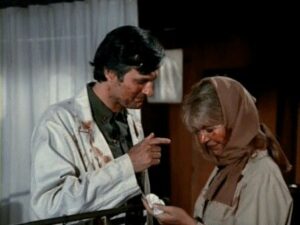
Moment 1: The First Real Crack in Margaret’s Armor
Early in the series, Margaret established herself as the embodiment of military professionalism—rigid, protocol-obsessed, and seemingly immune to Hawkeye’s charms. However, one pivotal moment shattered this perception. After an especially devastating surgical session, Margaret’s carefully constructed walls crumbled. Faced with a situation she couldn’t control or fix through discipline, she allowed her vulnerability to surface.
Rather than exploit this moment for comedy or mockery, Hawkeye surprised everyone—including Margaret—with genuine emotional sensitivity. He didn’t offer patronizing comfort or attempt to minimize her concerns. Instead, he simply acknowledged her humanity, sitting with her distress while affirming her fundamental strength. His response communicated that he understood her pain wasn’t weakness but the natural consequence of caring deeply in an environment designed to destroy caring people.
This moment was revolutionary because it revealed that Hawkeye’s humor masked genuine empathy. Margaret realized that his pranks and irreverence weren’t disrespect but survival mechanisms identical to her professional rigidity. This mutual recognition transformed their entire relationship. They stopped viewing each other as adversaries and began seeing each other as fellow survivors using different strategies to endure shared trauma. This understanding became the foundation for every meaningful interaction that followed.

Moment 2: The Unspoken Surgical Partnership
Some of Margaret and Hawkeye’s most powerful moments occurred not during conversation but during surgery. Working side-by-side in the operating room, they developed an almost supernatural synchronization that transcended typical professional coordination. Their partnership became a physical manifestation of deep understanding and mutual respect.
During critical procedures, Margaret anticipated Hawkeye’s needs before he articulated them. She would position instruments exactly where he expected them, respond to his subtle movements with intuitive precision, and maintain absolute confidence in his decisions even under impossible pressure. This surgical dance revealed the depth of their connection—they had internalized each other so completely that verbal communication became almost superfluous.
What distinguished these moments from typical romantic television was their authentic grounding in professional reality. In the operating room, Margaret wasn’t a love interest or romantic rival but an equal partner in life-or-death work. This genuine professional respect formed the bedrock of their personal connection, proving that their bond extended far beyond physical attraction into intellectual and professional compatibility. They trusted each other with patients’ lives, which created a foundation of faith that transferred to personal matters.

Moment 3: The Private Confession and Shared Vulnerability
In one of the series’ most tender yet devastating scenes, Margaret allowed herself complete vulnerability with Hawkeye. Away from camp’s chaos and observant eyes, she confessed her deepest fears—doubts about her medical competence, romantic disappointments, terror that the war was fundamentally altering who she was at her core.
Rather than offering false reassurance or attempting to fix her pain, Hawkeye reciprocated with his own vulnerabilities. He spoke about his fears, his doubts, his struggle to maintain emotional coherence in an incoherent environment. This mutual revelation created a sacred space where both could be authentically human rather than performing roles demanded by military structure and gender expectations.
This moment’s power came from its refusal to be performative or dramatically resolved. There was no swelling music, no cinematic kiss, no suggestion that honest conversation would magically resolve their pain. Instead, there was only raw acknowledgment—two people recognizing they were being fundamentally altered by circumstances beyond their control and finding solace in shared understanding. They didn’t solve each other’s problems; they simply bore witness to each other’s suffering, which proved more meaningful than any solution could be.

Moment 4: The Protective Fury and Unwavering Loyalty
Throughout the series, Hawkeye displayed fierce protective instincts toward Margaret. When others disrespected her, questioned her competence unfairly, or posed genuine threats, his response was immediate and unequivocal fury. This wasn’t romantic posturing but authentic anger at anyone threatening someone he genuinely cared about.
Margaret reciprocated this protective energy with equal intensity. She fiercely defended Hawkeye when his abilities were questioned, when his emotional state deteriorated, or when others attempted to exploit his vulnerabilities. These moments revealed that their investment in each other’s wellbeing extended beyond personal affection into profound commitment to protecting each other from harm.
What made these protective moments authentic was their spontaneity and lack of announcement. Hawkeye and Margaret didn’t declare their protective feelings; they simply acted on them instinctively. The audience recognized these moments as evidence of care transcending conventional romance, revealing people genuinely committed to each other’s survival and dignity.

Moment 5: The Silent Understanding That Defined Everything
Perhaps the most sophisticated Margaret and Hawkeye moments required absolutely no dialogue. A glance across a crowded mess tent communicated volumes. A subtle gesture during chaos conveyed understanding. The way they positioned themselves near each other during difficult moments spoke to unspoken commitment and mutual support.
These silent moments demonstrated that their connection had achieved something rare in television—genuine friendship rooted in mutual respect, shared trauma, and authentic care. They didn’t need elaborate declarations because their bond had become woven into the fabric of who they were at the 4077th. Other characters could read their unspoken language; their connection had become that obvious to observers.

The Lasting Legacy
Margaret and Hawkeye’s relationship transcended typical television romance by refusing simple categorization. They were simultaneously romantic interests, platonic friends, professional partners, emotional anchors, and survival companions. Their moments—filled with tension, tenderness, humor, and genuine conflict—created a portrait of human connection that continues resonating with audiences decades later.
Their dynamic proved that the most meaningful relationships are built on genuine understanding, mutual respect, and the ability to see and accept each other completely. In an environment designed to break people, Margaret and Hawkeye found in each other a refuge and mirror—proof that authentic connection flourishes even in humanity’s darkest hours.