The Internet Can’t Stop Laughing at MAGA’s Latest Self-Own
When Rob Reiner tweeted his praise for President Joe Biden’s administration on Friday, declaring “It’s long past time that we acknowledge the sure handed, effective, grace under fire, success of Joe Biden’s Presidency,” he probably expected some pushback from conservative circles. What he likely didn’t anticipate was becoming the center of one of the most beautifully ironic moments in recent social media history.
Within hours, Donald Trump loyalists and MAGA supporters flooded Twitter with responses, resurrecting a vintage insult from Reiner’s acting days. The term “meathead” quickly began trending across the platform, with conservatives wielding it as their weapon of choice against the liberal filmmaker. There was just one glaring problem with their strategy—a problem so obvious that it left the rest of Twitter absolutely howling with laughter.

The Irony That Writes Itself
For those who need a quick television history lesson, Rob Reiner played Michael Stivic in Norman Lear’s groundbreaking sitcom “All in the Family,” which aired from 1971 to 1980. Stivic was Archie Bunker’s son-in-law—a liberal, educated young man of Polish descent who frequently clashed with his father-in-law’s outdated worldview. Archie Bunker, the show’s central character, routinely called Michael “meathead” throughout the series’ nine-season run.
Here’s the crucial detail that MAGA supporters apparently missed, ignored, or never understood: Archie Bunker was the villain of the piece. He was the ignorant, bigoted, close-minded antagonist whose entire purpose was to represent everything wrong with prejudice and intolerance. The show’s brilliance lay in how it satirized Bunker’s racist, sexist, and xenophobic views, using comedy to expose the absurdity of bigotry. Audiences weren’t supposed to admire Archie Bunker—they were supposed to laugh at him and recognize the harm his worldview caused.
By calling Rob Reiner “meathead,” Trump supporters inadvertently positioned themselves as the Archie Bunkers of this scenario—the out-of-touch bigots whose views are meant to be mocked and rejected. The self-own was so perfect, so completely lacking in self-awareness, that it instantly became social media gold.

Twitter Responds with Perfect Clarity
The response from other Twitter users was swift and merciless. One observer captured the situation perfectly: “The right wing just can’t help clowning themselves every time. By calling Rob Reiner ‘meathead,’ they’re taking the part of the old white racist bigot! Unlike Archie Bunker however, they refuse to learn and be better. That’s what made the show so important by teaching how to change.”
Another user spelled it out even more directly: “Meathead is trending because MAGA is calling Rob Reiner that name from his old show. You know, the show in which the main character—whose ignorant, out-of-touch, and bigoted views were the butt of every joke—called him Meathead. Take all the time you need to puzzle that out.”
The incident perfectly encapsulates a broader pattern of cultural misunderstanding. Time and again, certain political movements have appropriated symbols, references, and rhetoric without grasping their original context or meaning. It’s reminiscent of conservatives who love rage against the machine without realizing the band’s explicitly anti-authoritarian, leftist politics, or those who blast Born in the USA at rallies while missing Bruce Springsteen’s critique of American militarism.
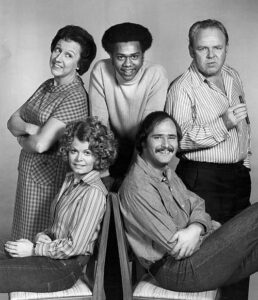
Understanding “All in the Family’s” Cultural Impact
Norman Lear’s creation wasn’t just entertainment—it was a cultural phenomenon that fundamentally changed what television could accomplish. “All in the Family” is widely recognized as one of the most important sitcoms in American broadcasting history, pioneering a dramatic edge that tackled hot-button sociopolitical and cultural issues head-on. At a time when most sitcoms stuck to safe, sanitized family dynamics, Lear’s show dove fearlessly into discussions about racism, sexism, homosexuality, women’s liberation, the Vietnam War, and religious prejudice.
The show’s genius was in its approach. Rather than preaching tolerance through earnest lectures, it held up a mirror to American bigotry through Archie Bunker, allowing audiences to see how ridiculous and harmful such views truly were. The character was deliberately crafted as a working-class man who believed every stereotype he encountered and found himself constantly surrounded by people he was prejudiced against—his liberal son-in-law, his increasingly independent daughter, his patient wife, and his diverse neighbors.
When the show premiered in 1971, it sparked considerable debate. Some worried that viewers would embrace Archie’s bigotry rather than reject it. But Lear’s satire was sharp enough that the show’s message came through clearly: Archie Bunker was not someone to emulate. He was someone to outgrow, someone whose outdated thinking belonged to a past that America needed to leave behind.
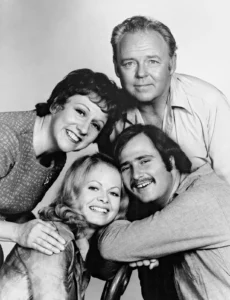
The Lesson MAGA Missed
The tragedy—or comedy, depending on your perspective—of the “meathead” incident is that it demonstrates exactly the kind of cultural stagnation that “All in the Family” warned against. The show’s entire arc involved characters learning, growing, and challenging their preconceptions. Even Archie Bunker himself underwent gradual evolution throughout the series, slowly becoming less rigid in his views.
By enthusiastically adopting Bunker’s insult without understanding its context, MAGA supporters revealed that they’ve learned nothing from the show’s message. They’ve identified with the character whose entire purpose was to represent ignorance that needed to be overcome. They’ve essentially announced to the world: “We are the Archie Bunkers, and we’re proud of it.”
The Silence Speaks Volumes
As of this writing, Rob Reiner hasn’t responded to the trending “meathead” hashtag or the delicious irony surrounding it. Perhaps he doesn’t need to—the internet has done the work for him, thoroughly explaining the joke to anyone willing to listen. Sometimes the best response to such spectacular self-owns is simply to let them speak for themselves.
The incident serves as a reminder that cultural literacy matters, that understanding the media we consume and the references we make is crucial to effective communication. It also demonstrates that satire, when done right, can create lasting impact—even if that impact takes decades to fully reveal itself in unexpected ways.