MAS*H didn’t just produce great television—it revolutionized the medium with episodes that broke rules, shattered conventions, and pushed boundaries in ways that seem bold even today. These special episodes weren’t just different; they were experimental masterpieces that took enormous creative risks. Behind each groundbreaking moment lay fascinating details that reveal just how much courage, innovation, and sheer determination went into creating television history.
“The Interview” Was Shot Documentary Style Without Traditional Lighting
Season four’s “The Interview” remains one of television’s most daring experiments. Shot in black and white when color television dominated, the episode featured a news correspondent interviewing the 4077th staff about their war experiences. What most viewers don’t realize is that cinematographer William Jurgensen deliberately used harsh, unflattering lighting to mimic actual combat zone documentary footage from the Korean War era.
The production team studied dozens of real Korean War documentaries, noting how battlefield cameramen worked with whatever light was available. They replicated this aesthetic by eliminating the carefully controlled studio lighting that normally made actors look polished and perfect. The result was raw, almost uncomfortably real footage that made viewers feel like they were watching actual war correspondence rather than scripted drama.
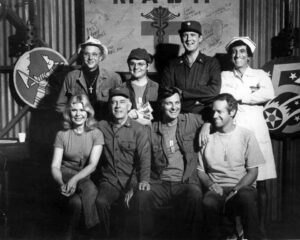
Even more fascinating was the decision to let actors break the fourth wall and speak directly to the camera—something sitcoms simply didn’t do in 1976. This choice created an intimacy and authenticity that transformed how television could tell stories. The episode earned director Larry Gelbart an Emmy and proved that audiences would embrace experimental formats if the content was compelling enough.
“Dreams” Required Actors to Reveal Their Deepest Character Interpretations
The surreal season eight episode “Dreams” asked each actor to develop their character’s nightmare, drawing from their years of playing these roles. What made this special was the creative freedom given to the cast—they essentially co-wrote their segments by working with the writers to craft dreams that reflected their understanding of their characters’ psychological depths.
Alan Alda’s dream sequence, where he operated on patients who turned into family members, was based on his own research into PTSD and the psychological toll of repeatedly performing traumatic surgery. Loretta Swit designed Margaret’s dream to reflect her character’s evolution from rigid military officer to compassionate human being struggling with the contradictions of being a woman in a male-dominated military structure.
The production required elaborate special effects unprecedented for a sitcom. Harry Morgan’s dream featured him sinking into the ground while his paperwork multiplied endlessly—a practical effect that required the actor to stand in a specially constructed platform that could be lowered while the camera angle created the illusion of him being swallowed by bureaucracy. The episode cost nearly double the normal budget but became one of MAS*H’s most memorable artistic achievements.
“Point of View” Was Filmed From a Wounded Soldier’s Perspective
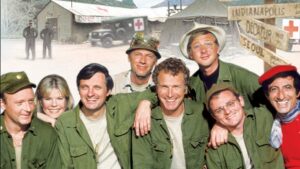
Season seven’s “Point of View” told an entire story from the perspective of a wounded soldier who couldn’t speak due to a throat injury. This meant the camera essentially became the patient, with actors performing directly to the lens for the entire episode. Director Charles S. Dubin faced enormous technical challenges making this work without becoming gimmicky or tiresome.
The cinematography required custom camera mounts that could be positioned at bed height and moved smoothly to simulate natural head movements. When other characters moved the patient, the camera had to move correspondingly, creating complex choreography between camera operators and actors. Scenes where the patient was transported on a stretcher required Steadicam technology that was still relatively new and difficult to use.
What most viewers miss is the incredible acting precision this demanded. Every actor had to perform directly to the camera while maintaining emotional authenticity and hitting precise marks for focus. Alan Alda spent hours helping actors adjust their performances for this unusual perspective, ensuring they maintained eye contact with the lens in ways that felt natural rather than theatrical. The result was an episode that created unprecedented empathy by literally putting viewers in a patient’s body.
“Goodbye, Farewell and Amen” Required Building an Entire Refugee Village
The two-and-a-half-hour series finale remains the most-watched television broadcast in American history, but few realize the scale of production involved. The episode’s centerpiece—a refugee village where a traumatic incident triggers Hawkeye’s breakdown—required constructing an entire Korean village from scratch on the Fox Ranch in Malibu.
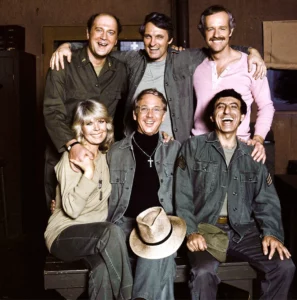
Production designer Walter M. Jefferies researched authentic Korean village architecture and imported materials to create period-accurate structures. The village included functional interiors, not just facades, because the script required extended scenes inside these buildings. The construction took six weeks and employed over fifty craftspeople working with architectural plans based on photographs of actual Korean War-era villages.
The bus sequence that triggers Hawkeye’s psychological crisis was filmed with extraordinary care to maintain both realism and sensitivity. The scene required precise coordination between dozens of extras playing refugees, the actors, and special effects teams creating the sense of danger from nearby combat. Director Alan Alda shot the sequence over three days, using multiple angles to create the claustrophobic tension essential to the story.
“The Army-Navy Game” Was Almost Entirely Improvised
Few fans know that this beloved episode featuring the camp obsessing over a football game radio broadcast was largely improvised by the cast. The script provided the basic situation and key plot points, but much of the dialogue—particularly the reactions to the unseen game—was created spontaneously by actors riffing off each other’s energy.
Alan Alda and Mike Farrell essentially performed a two-man comedy show as they provided running commentary on the game, making up absurd plays and reactions in real-time. The director shot these scenes with multiple cameras running continuously, letting the actors play without stopping for traditional shot-by-shot coverage. This created genuine spontaneity and natural comedic timing impossible to achieve with scripted, carefully planned shots.
The episode’s behind-the-scenes secret was that no actual football game audio was used—the actors couldn’t hear anything from the radio prop. They were reacting to silence, creating both the game action and their responses to it entirely through imagination and improvisation. This required the cast to maintain a shared imaginary timeline of game events, coordinating their reactions without any external reference. The result was organic, hilarious chaos that felt completely authentic.
“Hawkeye” Featured Alan Alda Performing a One-Man Show
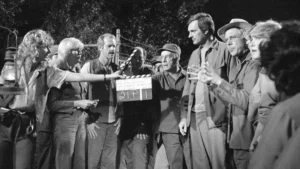
When Hawkeye crashes his jeep and suffers a concussion in season four’s “Hawkeye,” the episode becomes essentially a one-man show with Alan Alda performing an extended monologue to stay conscious. What viewers don’t realize is that this episode was written specifically to give the rest of the cast a week off while Alda carried the entire production.
The technical challenge was maintaining visual interest during a single-location, single-character episode. Director Larry Gelbart used dynamic camera angles, creative framing, and strategic movement to prevent the episode from becoming static. The Korean farmer who couldn’t understand English—played by authentic Korean actor Clyde Kusatsu—provided a perfect foil without requiring dialogue that would break the isolation Hawkeye felt.
Alda rehearsed the episode like a stage play, memorizing the entire thirty-minute monologue and performing extended takes with minimal cuts. Some sequences run for several minutes without edits, unprecedented for television sitcoms that typically cut every few seconds. This required absolute precision in performance, blocking, and camera operation. The episode proved that MAS*H’s strength lay in character depth and writing quality, not just ensemble chemistry.
“A War for All Seasons” Spanned an Entire Year in Twenty-Two Minutes
This ingenious episode compressed an entire year at the 4077th into a single episode by showing fragments of each month, creating a time-lapse effect that illustrated the grinding repetitiveness of war. The technical execution required meticulous continuity tracking and creative transitions that audiences barely noticed but which demanded extraordinary planning.
The wardrobe department created subtle costume variations showing wear and replacement throughout the year. Props showed seasonal changes—decorations for various holidays, changing weather conditions reflected in mud versus dust, and evolving personal effects showing time passing. These details created subliminal authenticity even though each “month” was only a few minutes of screen time.
Director Burt Metcalfe used transitional shots of the camp bulletin board changing to mark time passing, but these required careful choreography to ensure lighting, weather, and background activity remained consistent within each time period while varying appropriately between them. The episode was essentially twelve mini-episodes woven together, requiring planning equivalent to a full season compressed into single production schedule.
“Tuttle” Introduced Imaginary Character Who Got Real Screen Time
In the iconic episode “Tuttle,” Hawkeye and Trapper John invent a fictitious officer to handle various camp problems. The brilliant detail most viewers miss is that “Tuttle” actually appears in background shots throughout the episode—played by a real actor in deliberately unfocused and partially obscured appearances.
This meticulous background work created the illusion that Tuttle existed just outside viewer perception. The actor would walk past windows, appear at the edge of frame, or be visible in crowd scenes but always slightly out of focus or turned away. This required precise blocking and camera work to maintain the gag while creating the sense that Tuttle was a real presence everyone kept missing.
The payoff—when Tuttle “dies” in a parachuting accident—required the production team to create actual memorial services and paperwork for a character who never truly appeared on screen. This commitment to the absurdist joke demonstrated MAS*H’s willingness to invest serious production resources into comedic concepts, trusting audiences to appreciate the layered humor.
“The Bus” Was Shot Almost Entirely on a Single Set
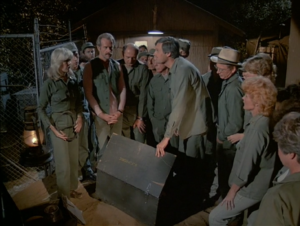
When the camp personnel become stranded on a broken-down bus in dangerous territory, the episode takes place almost entirely within the confines of the vehicle. This seemingly simple premise required building a complete bus interior on a soundstage with removable walls for camera access while maintaining the claustrophobic atmosphere essential to the story.
The production design team created a functional bus interior mounted on a gimbal system that could rock and tilt to simulate movement without actually traveling. Windows featured rear-projection screens showing Korean countryside footage, but achieving proper perspective and lighting to make this look realistic required extensive testing and calibration.
The episode’s power came from the acting ensemble working in genuinely cramped conditions. The tight quarters weren’t just visual—actors really were pressed together, making the tension and discomfort authentic. Director Larry Gelbart choreographed movement within the space like a dance, ensuring cameras could capture reactions while maintaining spatial continuity. The result was an episode that transformed limitation into artistic strength.
“Follies of the Living – Concerns of the Dead” Featured a Ghost Character
This remarkable episode featured a dead soldier observing the camp and providing philosophical commentary on life, death, and meaning. What makes this fascinating is how the production handled having a character who could interact with the environment but wasn’t visible to other characters.
The ghost, played by Loudon Wainwright III, required careful blocking to ensure he never accidentally appeared to interact with other actors while still seeming present in the scenes. Camera angles had to be chosen so he could observe without creating eyeline problems that would break the illusion of invisibility. In scenes where he touched objects, props required special rigging to move “on their own.”
The episode’s philosophical depth pushed MAS*H into genuinely experimental territory rarely attempted by sitcoms. The writing tackled mortality, purpose, and the randomness of death in war with unusual directness, using the ghost character to articulate questions characters couldn’t ask themselves. This bold choice risked alienating audiences but instead created one of the series’ most thought-provoking episodes.
Why These Details Matter
These fascinating behind-the-scenes details reveal that MAS*H’s special episodes weren’t just well-written—they were technical and artistic achievements that required innovation, risk-taking, and extraordinary craft. The show’s willingness to experiment with format, challenge conventions, and trust audiences to embrace unconventional storytelling helped transform television from simple entertainment into genuine art.
Understanding these details deepens appreciation for both the visible final product and the invisible artistry that made it possible. MAS*H’s special episodes remain special not just because of their content but because of the vision, skill, and courage required to create television that had never been attempted before and has rarely been matched since.