MASH built its legendary status on relationships that evolved in unexpected and often revolutionary ways for television of its era. What began as simple character dynamics—the prankster, the by-the-book officer, the innocent clerk—transformed into complex interpersonal connections that defied audience expectations and challenged television conventions. The show’s writers took extraordinary risks with these relationships, trusting that viewers would embrace complexity over comfort and authenticity over easy answers. These three revelations about how characters actually related to each other demonstrate why MASH transcended typical sitcom formulas to become something far more profound and enduring.
Former Enemies Became Each Other’s Deepest Confidants
Perhaps the most stunning character evolution in MAS*H history was the transformation of Margaret Houlihan and Hawkeye Pierce from bitter adversaries into genuine friends who understood each other better than almost anyone else in their lives. In early seasons, their relationship was purely antagonistic—Margaret represented military rigidity and mindless rule-following while Hawkeye embodied anti-authoritarian rebellion and contempt for military protocol. They seemed fundamentally incompatible, existing on opposite sides of an unbridgeable ideological divide. Margaret reported Hawkeye’s infractions with vindictive pleasure, while Hawkeye mocked her affair with Frank Burns and dismissed her as a military automaton incapable of independent thought. Their mutual contempt provided easy comedy but seemed destined to remain static.

The gradual shift in their relationship represented some of television’s most sophisticated character development. It didn’t happen through a single dramatic event but through accumulated moments of reluctant recognition that they were more alike than different. Both were deeply competent medical professionals committed to saving lives despite disagreeing about almost everything else. Both used their public personas—his irreverence, her strict military bearing—as armor against the psychological devastation of wartime medicine. As Margaret’s character deepened beyond one-dimensional caricature, particularly after her divorce, Hawkeye began recognizing her vulnerability and strength. She wasn’t blindly following orders but desperately trying to maintain control and dignity in circumstances designed to strip both away.
What made this evolution revolutionary was that the show never forced them into romance, which would have been the conventional television solution. Instead, MAS*H portrayed something rarer and more valuable—genuine platonic intimacy between a man and woman who respected each other’s minds and trusted each other’s hearts. By later seasons, Margaret sought Hawkeye’s counsel on personal matters, while Hawkeye confided fears and doubts to Margaret that he hid from everyone else. Their late-night conversations revealed two people who had earned the right to see past each other’s defenses. The scene where Margaret admits she envies Hawkeye’s courage to openly oppose the war, and he responds that he envies her ability to find meaning in military service, captured the mutual respect their relationship had achieved. They remained ideologically opposed but had learned that disagreement doesn’t preclude love, that you can fundamentally respect someone whose worldview differs entirely from your own.

The Father-Son Dynamic Nobody Saw Coming
When Harry Morgan joined MAS*H as Colonel Sherman Potter, replacing the beloved McLean Stevenson as commanding officer, fans worried the show would suffer irreparable damage. Instead, the writers created one of television’s most moving father-son relationships between Potter and virtually every younger character at the 4077th, particularly Hawkeye and B.J. What made this unexpected was that Potter arrived as a career military officer, exactly the type of lifer that Hawkeye had spent years mocking and opposing. By conventional sitcom logic, Potter should have been another antagonist, another target for Hawkeye’s anti-military satire.
The genius lay in how the show developed Potter as a complete human rather than a military stereotype. He was career Army but not blindly so—he had decades of experience watching young men die in wars he increasingly questioned, though duty and loyalty kept him serving. He enforced military discipline but with pragmatism and humanity, understanding when to look the other way and when to put his foot down. Most importantly, Potter genuinely loved the young doctors under his command and demonstrated that love through actions rather than words. He protected them from higher-ups, fought for their supplies and leave time, and provided the stability and wisdom they desperately needed.
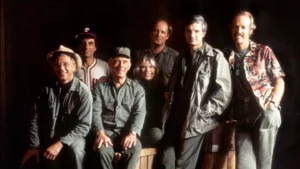
What developed between Potter and Hawkeye was particularly profound given their ideological differences. Hawkeye never stopped opposing the war or military culture, and Potter never stopped being a soldier, yet they formed a bond of profound mutual affection and respect. Potter became the father figure Hawkeye needed—someone who could hear his cynicism and anger without taking offense, who could provide perspective without invalidating his pain, who could discipline him when necessary while still believing in his essential goodness. The episodes where Potter talked Hawkeye through psychological crises, or where Hawkeye risked punishment to protect Potter from his own stubborn pride, revealed a relationship based on unconditional love despite fundamental disagreements.
The unexpected element was that MAS*H portrayed this father-son dynamic as strengthened rather than weakened by their differences. Potter didn’t need Hawkeye to become a good soldier, and Hawkeye didn’t need Potter to become anti-military. They loved each other as they were, finding common ground in shared humanity and medical mission rather than ideology. This representation of family bonds transcending political and philosophical differences feels particularly relevant today, offering a model for maintaining connection across divides that seem unbridgeable.
The Show’s Greatest Love Story Was Between Two Men
The relationship between Hawkeye Pierce and B.J. Hunnicutt stands as one of television’s most intimate portrayals of male friendship, and what made it shocking for 1970s and 1980s audiences was the show’s willingness to depict emotional and physical affection between heterosexual men. This wasn’t buddy comedy built on insults and emotional distance—this was genuine love expressed openly and without shame. Hawkeye and B.J. hugged, held hands during difficult moments, said “I love you” to each other, cried together, and depended on each other with an intensity that television rarely allowed between male characters who weren’t related by blood.
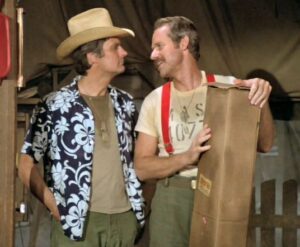
The depth of their connection went beyond friendship into something approaching romantic intimacy minus the sexual component. They knew each other’s fears, dreams, and secrets better than anyone else, including their wives back home. They completed each other’s sentences, communicated through glances, and experienced jealousy when the other formed close connections with someone new. B.J.’s occasional resentment of Hawkeye’s lingering attachment to Trapper John’s memory resembled a spouse’s jealousy of a former relationship. Their arguments had the intensity of lovers’ quarrels, cutting deep because they mattered so profoundly to each other.
What made this revolutionary was the show’s complete confidence in depicting this intimacy without anxiety about homosexual implications or the need to constantly reassert the characters’ heterosexuality through crude jokes or aggressive masculinity. MAS*H simply showed two straight men loving each other deeply, physically affectionately, and emotionally vulnerably, modeling a form of masculine friendship that mainstream media rarely portrayed. The famous scene where they embrace after a near-death experience, holding each other while crying and repeatedly saying “I thought I’d lost you,” would have been a romantic scene between a man and woman. Between two men, it was radical representation of how male friendship could look when freed from toxic masculinity’s constraints.

The series finale crystallized this when B.J., who had struggled to say goodbye, left Hawkeye a final message spelled out in stones on the hillside: “GOODBYE.” Hawkeye’s tearful, joyful reaction to discovering this message—the way he traced the letters with his eyes while smiling through tears—captured the essence of their relationship. It was a love story, just not the kind television typically told. MAS*H demonstrated that the deepest human connections transcend romantic and sexual categories, that love between friends can be as profound, intimate, and life-defining as any romantic relationship.
These three unexpected relationship dynamics—former enemies becoming confidants, an unlikely father-son bond across ideological divides, and male friendship portrayed with romantic-level intimacy—exemplify why MAS*H remained groundbreaking. The show understood that authentic human relationships defy simple categories and comfortable predictions, that real connection requires seeing past surfaces to recognize shared humanity underneath.