When Television Grew a Conscience: The Revolutionary Legacy of All in the Family
Before January 12, 1971, American television was a sanitized fantasyland where married couples slept in separate beds, problems were solved in thirty minutes, and controversial topics were as welcome as a skunk at a garden party. Then Norman Lear introduced the Bunker family to America, and nothing would ever be the same.
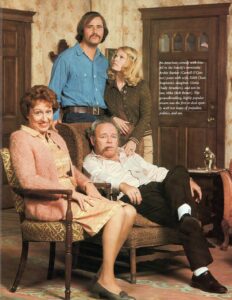
“All in the Family” didn’t tiptoe around the elephant in the room—it rode that elephant straight through the picture window of polite society. The show centered on Archie Bunker, a working-class loading dock foreman from Queens, New York, whose casual bigotry and reactionary views were matched only by his wife Edith’s patience, his daughter Gloria’s progressive idealism, and his son-in-law Mike’s liberal activism. What made the show groundbreaking wasn’t just that it acknowledged America’s divisions—it put them center stage, in your face, impossible to ignore.
Carroll O’Connor’s portrayal of Archie Bunker became one of television’s most complex achievements. Archie was lovable and infuriating in equal measure, a man whose prejudices were real and ugly, yet whose humanity peeked through in unexpected moments. He called his wife a “dingbat,” his son-in-law “Meathead,” and held opinions that would make modern audiences gasp. But that was precisely the point. Norman Lear understood something revolutionary: you could make people examine their own prejudices by making them laugh first.
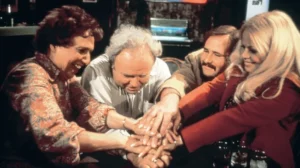
The Courage to Confront
What set “All in the Family” apart from every sitcom before it was its fearless approach to subjects that polite society whispered about but never discussed openly. Race relations, feminism, homosexuality, rape, menopause, miscarriage, religious hypocrisy, the Vietnam War, gun control, and social inequality—topics that made network executives break out in cold sweats—became the fabric of weekly storylines.
The show’s writers didn’t preach or lecture. Instead, they created a pressure cooker environment where the Bunker living room became America’s living room, and the arguments that erupted between liberal Mike and conservative Archie reflected the debates happening at dinner tables across the country. Jean Stapleton’s Edith served as the show’s moral compass, her gentle wisdom often cutting through the noise with devastating clarity. Sally Struthers and Rob Reiner brought youthful energy and idealism, representing a generation determined to change the world their parents had created.
The Norman Lear Genius
As New Yorker critic Michael Arlen observed, Norman Lear possessed an almost supernatural ability to “feel what people want to see before they know they want to see it.” This wasn’t accidental. Lear understood that comedy could be a Trojan horse for social commentary, that laughter could disarm defenses and open minds that remained closed to traditional messaging.
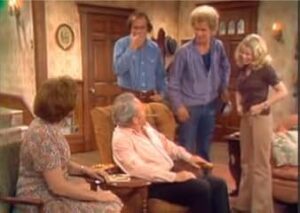
The book “All in the Family: The Show that Changed Television” offers unprecedented access to Lear’s creative process. With previously unseen notes, script pages, and production designs, readers discover how the show’s most controversial episodes came to life. Lear personally selected fifty essential episodes that exemplify why the series remains relevant more than five decades after its premiere, providing his own commentary alongside insights from the cast, writers, directors, and guest stars who brought these stories to life.
A Legacy That Endures
What’s remarkable about “All in the Family” isn’t just that it tackled controversial subjects—it’s that those subjects remain controversial today. The issues that divided the Bunker family in 1971 still divide families in 2025. Gun control, racial justice, women’s rights, economic inequality, political polarization—turn on the news any evening, and you’ll find Archie and Mike still arguing, just wearing different faces.
The show’s influence on television cannot be overstated. It shattered the mold, proving that audiences were hungry for content that reflected their real lives, complete with uncomfortable truths and unresolved tensions. Norman Lear’s subsequent successes—”The Jeffersons,” “Maude,” “Good Times,” “One Day at a Time”—all followed the template established by “All in the Family,” using humor to explore society’s fault lines.
Why This Book Matters Now
Jimmy Kimmel, who penned the foreword and executive produced the Emmy-winning “Live in Front of a Studio Audience” recreations of classic Lear episodes, represents a new generation of creators influenced by Lear’s fearless approach. The book, co-authored by television historian Jim Colucci, serves as both a time capsule and a mirror, showing us how far we’ve come and how far we still need to go.
For superfans and newcomers alike, this companion book offers something rare: the opportunity to understand not just what happened on screen, but why it mattered. The behind-the-scenes insights reveal the battles fought with network censors, the creative risks that paid off, and the moments when the show transcended entertainment to become cultural touchstone.
Norman Lear, who won his first Emmy Awards in 1971 and his most recent in 2020 (spanning an incredible five decades), created more than a successful sitcom. He created a template for how television could serve as both mirror and lamp—reflecting society while illuminating paths forward. His memoir “Even This I Get to Experience” captures a life dedicated to using entertainment as a force for social progress, and this companion book to “All in the Family” demonstrates how that philosophy transformed American television.

The Enduring Question
As you explore this comprehensive look at television’s most revolutionary sitcom, one question emerges: In an era of peak television with hundreds of channels and streaming services, could a show like “All in the Family” succeed today? Or have we become too fragmented, too polarized, too entrenched in our echo chambers to sit together and laugh at our own contradictions?
Perhaps that’s why revisiting “All in the Family” matters more now than ever. It reminds us of a time when a single show could bring an entire nation together, not by avoiding controversy, but by diving headfirst into it with humor, humanity, and hope that understanding might follow laughter.
The Bunker family’s living room remains open, the arguments continue, and the lessons remain unlearned. But the laughter—honest, uncomfortable, cathartic laughter—still echoes across five decades, reminding us that the first step toward change is acknowledging who we really are.