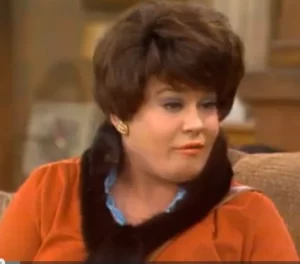
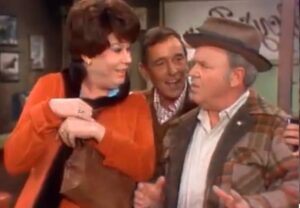
On September 29, 1975, All in the Family introduced audiences to one of television’s most groundbreaking characters: Beverly LaSalle, portrayed by drag performer Lori Shannon (the stage persona of comedian Don Seymour McLean). In the episode “Archie the Hero,” the notoriously bigoted Archie Bunker, played brilliantly by Carroll O’Connor, performs mouth-to-mouth resuscitation on an unconscious passenger in his taxicab, saving her life. When Beverly arrives at the Bunker household to express gratitude, Archie discovers the shocking truth—Beverly is a man who performs in women’s clothing. The episode masterfully explored Archie’s internal struggle as he grappled with his prejudices, horrified that he had “put his mouth on another man’s mouth.” This comedic setup became the foundation for one of television’s most progressive storylines about acceptance and human dignity.
Beverly Becomes Family
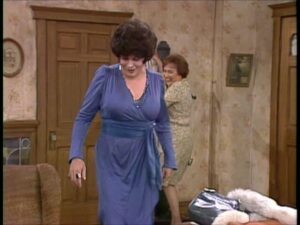
What made Beverly LaSalle extraordinary wasn’t just the initial shock value, but how the character evolved into a beloved friend of the Bunker family. Edith Bunker, portrayed with warmth and compassion by Jean Stapleton, immediately embraced Beverly with open arms and genuine affection. Their friendship blossomed naturally and beautifully, transcending the prejudices of the era. Beverly returned in the November 6, 1976 episode “Beverly Rides Again,” where her drag persona was cleverly used to play an elaborate prank on Archie’s irritating friend Pinky, played by Eugene Roche. Through these appearances, Beverly became more than a one-dimensional character designed to challenge Archie’s bigotry—she became a fully realized person with humor, dignity, and depth. The show demonstrated that drag performers and LGBTQ+ individuals deserved representation that went beyond stereotypes and mockery.
The Devastating Turn: Edith’s Crisis of Faith
The December 18, 1977 episode “Edith’s Crisis of Faith” took a dramatically dark turn that shocked the nation and remains emotionally powerful decades later. Audiences learned that Beverly LaSalle had been brutally murdered by a gang of homophobic attackers while walking with Mike Stivic, Rob Reiner’s character, during the Christmas season. Beverly was beaten to death simply for being who she was—a hate crime that reflected the horrifying reality facing LGBTQ+ individuals in 1970s America and, tragically, continues to resonate today. The episode didn’t shy away from the brutality of the crime or its emotional aftermath. Edith, devastated by the senseless murder of her dear friend, experienced a profound crisis of faith that questioned the very foundation of her beliefs. How could a loving God permit such hatred and violence to exist in the world? For a character previously portrayed as devoutly religious, this spiritual breakdown represented a seismic shift in the show’s dynamics and challenged viewers to confront uncomfortable questions about faith, justice, and human cruelty.
Norman Lear’s Vision and Network Pressure
Show creator Norman Lear discussed the episode’s creation and significance in a revealing 2014 interview with Deadline, explaining the careful thought process behind Beverly’s tragic storyline. Lear had always wanted to tell emotionally difficult, harrowing stories that reflected real social issues, and Beverly’s murder provided that opportunity. He explained the creative journey: “What could cause Edith Bunker to lose her faith? And I thought, ‘This woman, this character is killed for being who she was.’ Edith couldn’t imagine a God that could allow that.” However, there was enormous pressure—both creatively and from the network—to resolve Edith’s loss of faith. Since Archie Bunker was characterized as an old-world conservative who took Christianity extremely seriously and often criticized potential atheists, having Edith become permanently atheist would fundamentally alter the show’s central relationship and dynamic.
The Resolution Dilemma
Lear and his writing team spent weeks struggling with how Edith could authentically regain her faith after such a traumatic event. The breakthrough came from an unexpected question during one of their creative sessions. Lear recalled: “At some point, weeks and weeks later, somebody innocently asked, ‘What happens to Archie when she loses her faith?’ Son of a b****. In that answer the regaining of her faith was inherent. She had to regain it to save him because he depended on a strong Edith.” This solution demonstrated the codependent nature of the Bunkers’ relationship—Edith’s strength and faith were pillars that supported Archie’s worldview. While some might argue it was unfortunate that Edith wasn’t allowed to fully explore her own spiritual journey following the death of a loved one, the performances by Jean Stapleton and Carroll O’Connor were nothing short of extraordinary. Both actors delivered mournful, deeply moving portrayals that captured genuine grief and the profound injustice of Beverly’s murder.
Cultural Impact and Historical Context
Beverly LaSalle holds a special place in television history as potentially the first openly, non-demonized queer character that many viewers of a certain generation encountered in mainstream media. At a time when LGBTQ+ representation was virtually non-existent or deeply stereotyped, Beverly was portrayed with humanity, humor, and dignity. The character’s death wasn’t gratuitous—it reflected the genuine violence that queer people faced daily during the 1970s. Just a few years before Beverly’s television appearances, the UpStairs Lounge, a gay bar in New Orleans, was deliberately set on fire in 1973, resulting in 32 deaths and 15 injuries. Incidents of “gay bashing” were tragically common, often going unreported or uninvestigated by authorities. By addressing this violence directly, All in the Family forced mainstream American audiences to confront the hatred and danger that existed just outside their doors—and perhaps within their own communities and hearts.
Legacy and Continuing Relevance
The Beverly LaSalle storyline remains shockingly relevant in 2024, as violence against LGBTQ+ individuals, particularly transgender people and drag performers, continues to make headlines. The episode’s willingness to tackle homophobic violence head-on, to show the devastating personal cost of hatred, and to challenge viewers’ prejudices through the lens of beloved characters like Edith and even Archie, demonstrated television’s power as a vehicle for social change. Don Seymour McLean, who brought Beverly to life through his drag persona Lori Shannon, was a celebrated figure in the comedy scene until his death in 1984. His portrayal gave dignity and humanity to a community that was largely invisible or ridiculed in mainstream media. The episodes featuring Beverly LaSalle stand as testament to Norman Lear’s commitment to using entertainment to address serious social issues, pushing boundaries and challenging audiences to examine their own prejudices. While the resolution of Edith’s faith crisis may have been influenced by network demands and the need to maintain the show’s central dynamic, the conversation sparked by Beverly’s story—about hate crimes, faith, acceptance, and the value of every human life—continues to resonate across generations.