Every great television series has its headliners—the names in the opening credits, the faces on the promotional posters, the characters everyone discusses when the show comes up in conversation. MAS*H certainly had its iconic leads: Hawkeye, Margaret, Radar, Klinger, and the rest of the core ensemble who carried the series through eleven remarkable seasons. Yet some of the show’s most memorable moments and deepest emotional resonance came not from these stars, but from supporting characters who appeared sporadically yet left indelible marks on the series and its audience.
What distinguished MASH from other television shows was its remarkable ability to develop a rich ecosystem of supporting characters who felt as real and essential as the main cast. These weren’t mere background players or one-dimensional guest stars brought in to service a single episode’s plot. They were fully realized individuals with distinctive personalities, recurring roles that built meaningful relationships with the core characters, and moments of brilliance that often stole entire episodes. Four supporting characters in particular transcended their limited screen time to become absolutely unforgettable parts of the MASH legacy.
Dr. Sidney Freedman: The Conscience of the Camp
Among all the supporting characters in MAS*H’s eleven-season run, none made a more profound impact with fewer appearances than psychiatrist Major Sidney Freedman, portrayed with gentle wisdom and subtle humor by Allan Arbus. Appearing in only twelve episodes out of the series’ total 251, Sidney nevertheless became an honorary member of the core cast, a character so beloved and essential that his rare appearances felt like visits from a trusted friend rather than a guest star dropping in.
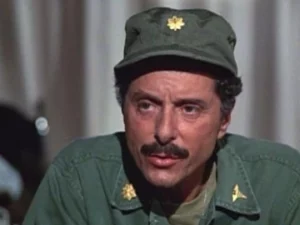
What made Sidney so remarkable was how his character functioned within the show’s ecosystem. As the 4077th’s consulting psychiatrist, he was called in when soldiers or staff members experienced psychological breaks—but his role extended far beyond clinical intervention. Sidney became the camp’s conscience, the wise observer who helped the characters (and viewers) make sense of the impossible contradictions of trying to save lives in the middle of a war designed to destroy them. His conversations with Hawkeye, in particular, created some of the series’ most thoughtful moments, as two intelligent men grappled with questions that had no easy answers.
Allan Arbus brought a distinctive quality to Sidney that perfectly suited the character’s function. He never played Sidney as the all-knowing authority figure dispensing wisdom from on high. Instead, Arbus portrayed him as someone who genuinely struggled with the same questions his patients faced, who used humor as skillfully as any surgeon at the 4077th to deflect pain, and who acknowledged the absurdity of trying to restore sanity in an insane situation. His famous observation that the camp’s members were “too smart to be happy” captured both the tragedy and the pride of the 4077th’s staff—they understood too much about what they were doing to find simple comfort in it.
Sidney’s most powerful moments came in the series’ later seasons, particularly in episodes like “Dear Sigmund” and the monumental series finale “Goodbye, Farewell and Amen.” In that final episode, Sidney helps Hawkeye recover a repressed memory so traumatic that his mind had constructed an elaborate fiction to avoid confronting it. The care and patience Arbus brought to those scenes, the way Sidney balanced professional skill with personal compassion, demonstrated why this character had become so essential. He was the person who could help the healers when they themselves needed healing.
Colonel Sam Flagg: The Paranoid Comic Relief
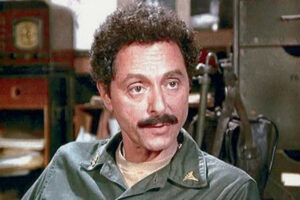
In stark contrast to Sidney Freedman’s gentle wisdom, Colonel Sam Flagg represented the show’s broadest comedy while simultaneously satirizing Cold War paranoia and intelligence agency overreach. Portrayed with manic intensity by Edward Winter across seven memorable episodes, Flagg was MAS*H’s resident intelligence agent—variously claiming affiliation with the CIA, CIC, or whatever agency suited his current cover story—whose conspiracy-driven worldview and over-the-top tactics provided some of the series’ most hilarious moments.
Flagg worked as a character precisely because Winter played him with absolute conviction. There was no winking at the audience, no acknowledgment of the absurdity. Flagg genuinely believed that communist infiltrators lurked everywhere, that every Korean civilian was a potential spy, and that his paranoid interrogation methods were not just necessary but patriotic. His physical presence added to the comedy—a ripped, intimidating figure who squinted constantly as if perpetually staring into the sun, who appeared and disappeared from camps like a deranged ninja, and who took himself so seriously that even his most ridiculous statements were delivered with complete sincerity.
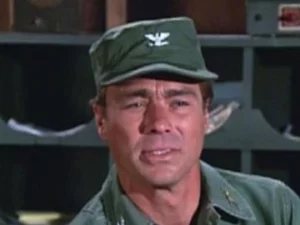
What elevated Flagg beyond simple comic relief was how his character functioned as social commentary. Through Flagg’s paranoid excesses, MAS*H satirized the McCarthy-era witch hunts, the intelligence community’s Cold War overreach, and the way fear could transform patriotism into persecution. His recurring presence reminded viewers that the war in Korea wasn’t just about military conflict—it was deeply entangled with ideological paranoia that destroyed lives as surely as bullets. When Flagg seriously questioned whether people were communist sympathizers for the most trivial reasons, the comedy carried a sharp edge.
Flagg’s interactions with the regular cast created wonderful dynamics. Hawkeye and B.J. treated him with the mockery he deserved, turning his visits into opportunities for elaborate pranks and verbal sparring. Margaret found him simultaneously attractive and appalling—drawn to his physical presence but repelled by his methods. Colonel Potter dealt with him as one military man to another, barely concealing his contempt for Flagg’s tactics while maintaining professional courtesy. These varied relationships gave the writers multiple ways to deploy Flagg’s particular brand of chaos whenever the show needed an injection of over-the-top comedy.
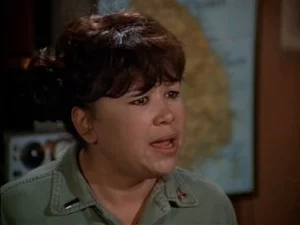
Nurse Kellye Yamato: The Heart in the Background
While some supporting characters made their mark through sporadic dramatic appearances, Nurse Kellye Yamato earned her place in fans’ hearts through quiet, consistent presence and one unforgettable moment of standing up for herself. Portrayed by Kellye Nakahara across more than 150 episodes—making her one of the series’ most frequently appearing supporting characters—Kellye worked primarily in the background, a competent, warm presence in the operating room and around camp who rarely received spotlight storylines.
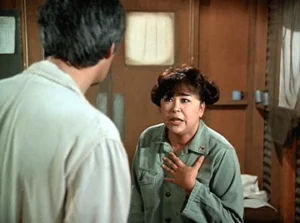
What made Kellye special was precisely this quality of being ever-present but underappreciated, which mirrored the experience of so many essential workers who keep organizations functioning without receiving recognition. Nakahara brought a genuine warmth and professionalism to every scene, creating a character who was clearly excellent at her job, supportive of her colleagues, and possessed of a quiet dignity that needed no spotlight to be appreciated. Regular viewers came to recognize her face, to look for her in crowd scenes, to appreciate the continuity she provided across the series’ many cast changes.
Then came the episode “Hey, Look Me Over” in Season 11, which finally gave Kellye her moment. After years of Hawkeye making casual remarks about not being attracted to her while simultaneously flirting with other nurses, Kellye confronts him directly, expressing her hurt and frustration in a monologue that was both powerful and overdue. The scene worked so beautifully because it acknowledged something viewers had likely noticed—that Kellye had been consistently overlooked despite her clear competence and warmth. Nakahara’s performance in that moment revealed depths to the character that had always been there but never received the opportunity to surface.
The response to that episode was overwhelming. Nakahara reportedly received bouquets of roses from cast and crew members congratulating her on finally getting a showcase for her talents. Fans recognized and appreciated seeing this long-time supporting character finally receive acknowledgment. “Hey, Look Me Over” became a favorite episode not just because of Kellye’s moment, but because it demonstrated MAS*H’s commitment to treating even its background characters with respect and depth.
Igor Straminsky: The Culinary Anti-Hero
If ever a character exemplified the phrase “you had to be there,” it would be Private Igor Straminsky, the 4077th’s much-maligned food service worker whose dubious culinary creations became a running joke throughout the series. Portrayed by Jeff Maxwell across multiple seasons, Igor represented every mess hall cook who ever tried to turn military rations into something resembling edible food, usually failing spectacularly but maintaining an endearing optimism about his efforts.
Igor worked as comic relief, certainly—his terrible food provided an endless source of complaints and jokes from the main characters. But what made Igor memorable was the genuine affection the show developed for him despite his culinary disasters. He wasn’t portrayed as incompetent or lazy; rather, he was doing his best with terrible ingredients, limited equipment, and impossible circumstances. His recurring attempts to dress up mystery meat, his occasional moments of surprising success (usually when he abandoned cooking and just served food raw or straight from cans), and his patient acceptance of constant complaints created a character who was simultaneously pathetic and admirable.
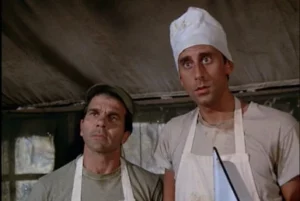
Maxwell played Igor with a hangdog quality that made him impossible to truly dislike. Even when serving food that looked genuinely inedible, Igor maintained a certain dignity and professionalism. He took pride in his work even when that work was universally derided. His interactions with the camp’s members—particularly his bickering with other support staff like Sergeant Zale—added texture to the world of the 4077th, reminding viewers that an entire infrastructure of enlisted personnel kept the camp running beyond the doctors and nurses who received most of the attention.
Igor’s presence also served a thematic purpose within MAS*H’s larger commentary on war and military life. The terrible food represented the deprivations and absurdities of war, the way even basic human needs became challenges in a combat zone. When episodes occasionally focused on food—like the famous “Adam’s Ribs” episode where Hawkeye becomes obsessed with ordering barbecue from Chicago—Igor’s usual offerings provided the contrast that made those moments resonate. He was the baseline of deprivation that made small pleasures precious.
Why These Characters Matter
These four supporting characters—Sidney, Flagg, Kellye, and Igor—represent different aspects of what made MAS*H extraordinary. Sidney provided intellectual and emotional depth, helping the show explore psychological trauma and philosophical questions with sophistication. Flagg delivered broad satire, using comedy to critique political and military excess. Kellye offered quiet humanity and continuity, representing the essential workers whose contributions often go unrecognized. Igor embodied the everyday struggles and small indignities of military life.
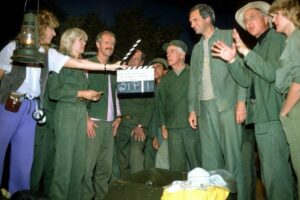
Together, they demonstrated MASH’s remarkable range—its ability to swing from philosophical depth to satirical comedy to gentle recognition of working-class dignity, often within the same episode. They proved that great television doesn’t just need great main characters; it needs a rich supporting cast that makes the world feel real, populated, and complete. Each of these characters could have been one-dimensional—the wise psychiatrist, the paranoid spook, the background nurse, the terrible cook—but MASH and its performers gave them layers, humanity, and memorable moments that elevated them beyond their supporting roles.
The fact that fans remember these characters decades after the series ended, that we can recall specific lines, episodes, and character moments despite their limited screen time, testifies to both the writing and performances that brought them to life. MAS*H succeeded not just because of Hawkeye, Margaret, and the core cast, but because characters like Sidney, Flagg, Kellye, and Igor made the 4077th feel like a real place populated by real people, each with their own stories, struggles, and moments of grace.