MAS*H built its reputation as more than a comedy by unflinchingly portraying war’s devastating emotional toll. While the show delivered countless laughs through eleven seasons, its most memorable moments came when laughter died and brutal truth took its place. These weren’t manufactured melodrama or emotional manipulation—they were authentic portrayals of how war destroys innocence, shatters illusions, and forces people to confront losses they’ll carry forever. The show’s willingness to break viewers’ hearts made its comedy more meaningful, its characters more human, and its legacy more enduring. These seven tragic moments remain seared into memory decades later because they revealed uncomfortable truths about war’s cost that no amount of comedy could erase.
Henry Blake’s Shocking Death
The episode “Abyssinia, Henry” (Season 3, Episode 24) delivered television’s most devastating gut-punch. After three seasons, Colonel Henry Blake received his discharge papers and was going home to Bloomington, Illinois. The camp threw him a farewell party filled with tears, laughter, and heartfelt goodbyes. Radar gave him a salute that broke both their hearts. Henry boarded the helicopter, waved goodbye, and viewers prepared for bittersweet but ultimately happy ending. Then came the final scene: Radar walked into the operating room where Hawkeye and Trapper were performing surgery and delivered news in a voice barely above whisper: “I have a message… Lieutenant Colonel Henry Blake’s plane was shot down over the Sea of Japan. It spun in. There were no survivors.”
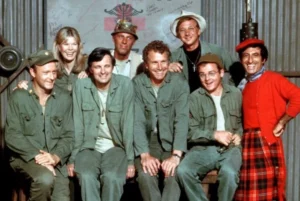
What made this moment so traumatic wasn’t just Henry’s death but its randomness and timing. He’d survived three years of war, earned his ticket home, and died minutes before reaching safety. The cast didn’t know this ending was coming—only a few people knew, ensuring their shock was genuine. McLean Stevenson’s departure from the show had been negotiated, but the decision to kill Henry rather than simply transfer him came from creator Larry Gelbart’s insistence on showing war’s arbitrary cruelty. People don’t always make it home. Good people die for no reason. War doesn’t care about happy endings. This moment shattered sitcom conventions and announced that MAS*H would never play by safe rules. Viewers who’d expected comfortable comedy were forced to confront the fact that war kills indiscriminately, that saying goodbye doesn’t guarantee seeing someone again, and that tragedy doesn’t announce itself—it simply happens.
Hawkeye Loses His Friend on the Operating Table
In “Sometimes You Hear the Bullet” (Season 1, Episode 17), MAS*H delivered its first genuinely heartbreaking episode. Hawkeye’s old friend Tommy Gillis visited the 4077th while writing a book about war titled “You Never Hear the Bullet That Kills You.” They laughed, reminisced, and promised to reunite stateside. Hours later, Tommy arrived on Hawkeye’s operating table, critically wounded. As Hawkeye frantically worked to save him, Tommy whispered that he’d been wrong about his book’s title—”Sometimes you hear the bullet”—and died despite Hawkeye’s desperate efforts.
This episode marked the first time MASH forced viewers to watch Hawkeye’s emotional armor crack completely. After pronouncing Tommy dead, Hawkeye walked to Henry’s office and broke down sobbing, confessing he’d never lost someone he knew personally before. All the soldiers he’d lost had been strangers—tragic but abstract. Tommy’s death made war devastatingly personal. The episode revealed that doctors aren’t invulnerable to grief, that surgical skill can’t overcome emotional attachment, and that losing someone you love hurts differently than losing someone you don’t know. This moment established MASH’s willingness to show that survival doesn’t mean escaping unscathed, that everyone breaks eventually, and that war’s most lasting wounds are often invisible. Gary Burghoff’s Radar, witnessing Hawkeye’s breakdown, offered him a teddy bear for comfort—a gesture so innocent and pure it somehow made the tragedy even more unbearable.
The Baby’s Death on Christmas
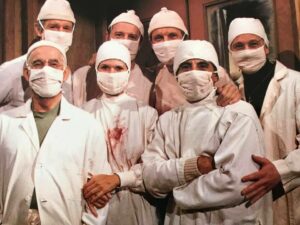
“Death Takes a Holiday” (Season 9, Episode 5) presented MAS*H’s darkest Christmas episode. The surgeons desperately tried keeping a critically wounded soldier alive until after midnight on December 25th so his family wouldn’t forever associate Christmas with his death. They succeeded through sheer determination and medical ingenuity, preserving Christmas Day as something other than tragedy for one family. Yet this noble effort created devastating irony: to keep the soldier alive required absolute silence, and when a Korean woman’s baby wouldn’t stop crying, the situation became desperate. The episode implied—without showing—that the mother smothered her own infant to prevent enemy soldiers from discovering their hiding place.
This moment represented MASH’s most controversial and disturbing storyline. It forced viewers to confront impossible moral mathematics: one life balanced against many, a mother’s unimaginable choice between her child and everyone else’s survival, and the question of whether any decision in such circumstances can be called “right.” The tragedy wasn’t just the baby’s death but what it did to everyone involved—the mother who made an impossible choice, the people who witnessed it, and viewers who had to acknowledge that war creates situations where every option is horrific. This storyline was based on true accounts from Korean War veterans, making its horror inescapably real. MASH never provided comfort or resolution, never suggested the baby’s death served higher purpose. Sometimes tragedy is just tragedy, and war forces humans into circumstances that destroy them regardless of what they choose.

Radar’s Heartbreaking Departure
“Good-Bye Radar” (Season 8, Episodes 4-5) wasn’t technically a death, but it felt like one to the 4077th and to viewers who’d watched Gary Burghoff’s Corporal Walter O’Reilly since the beginning. When Radar received news that his uncle died and his mother needed him home to run the family farm, he faced agonizing choice between duty to family and loyalty to the 4077th family that had become his entire world. Radar had been the show’s innocent heart—the naive farm boy whose childlike wonder survived three years of war that hardened everyone else. His departure meant that innocence finally couldn’t survive anymore.
What made Radar’s goodbye so devastating was its messiness. There wasn’t time for proper farewells because wounded arrived exactly when Radar needed to leave. His goodbye to Hawkeye consisted of hurried salute exchanged between operating tables, no words spoken because surgery demanded their attention even in this profound moment. Before leaving, Radar gave Hawkeye his most precious possession—his teddy bear—symbolizing that he was leaving childhood behind forever. This gift destroyed viewers because it acknowledged that war takes innocence even from those who survive. Gary Burghoff was going through real divorce during filming, and his genuine emotional devastation bled into the performance, making Radar’s departure feel heartbreakingly authentic. The character who’d represented the possibility of remaining good despite war’s corruption was leaving, and nothing would quite be the same.
Father Mulcahy Loses His Hearing
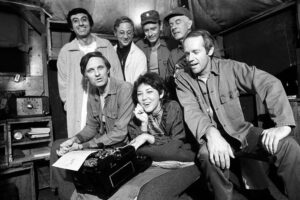
In the series finale “Goodbye, Farewell and Amen,” Father Mulcahy suffered permanent hearing loss after an explosion while he was rescuing POWs. What made this particularly tragic was the character involved—Mulcahy had been the show’s quietest, most selfless presence, always serving others while neglecting himself. His hearing loss became metaphor for how war damages those who give most selflessly, how service requires sacrifice, and how heroism often costs more than we can afford to pay.
The tragedy deepened because Mulcahy’s deafness wasn’t immediately discovered—he hid it while crisis after crisis demanded attention, not wanting to burden anyone with his problems. When finally forced to admit he couldn’t hear, Mulcahy broke down not because he’d lost his hearing but because he feared losing his purpose. How could he minister to people if he couldn’t hear their confessions, their fears, their prayers? The finale suggested his hearing might return partially, but never fully—fitting for a show that refused neat resolutions. William Christopher played Mulcahy’s devastation with such quiet dignity that it hurt more than any dramatic outburst could have. This moment reminded viewers that the people who hold everyone else together often have no one holding them, that selflessness has costs we only see when it’s too late, and that war damages even—perhaps especially—the best among us.
The Smothered Baby and Hawkeye’s Complete Breakdown
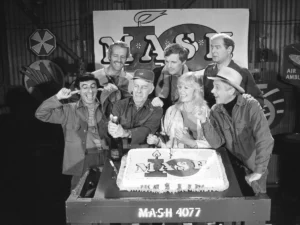
The series finale’s most disturbing revelation came when psychiatrist Sidney Freedman helped Hawkeye recover repressed memory. Hawkeye recalled being on a bus with refugees fleeing enemy territory when enemy soldiers approached. Everyone had to remain absolutely silent or be discovered and killed. A Korean woman’s baby began crying, and Hawkeye repeatedly told her to keep it quiet. What Hawkeye’s traumatized mind remembered as a woman smothering a chicken was actually the woman smothering her own baby to save everyone else.
This revelation destroyed Hawkeye because he blamed himself—his angry demands to silence the “chicken” had pressured the mother into unthinkable action. The trauma fractured his sanity completely, leading to his hospitalization. What made this moment so devastating was acknowledging that war creates situations with no right answers, where survival requires horror, where innocent people make impossible choices that destroy them forever. Hawkeye’s breakdown represented the accumulated cost of eleven seasons watching people die, making impossible choices, and maintaining sanity in insane circumstances. This storyline—based on true accounts from Korean War veterans—forced viewers to confront war’s ultimate obscenity: it makes humans do things that make them unable to live with themselves afterward.
The Final Goodbye Between Hawkeye and B.J.
The series finale’s emotional climax came in the silent, wordless goodbye between Hawkeye Pierce and B.J. Hunnicutt. After years fighting side by side, sharing everything from surgeries to psychological breakdowns, they faced final separation as the war ended. B.J. had promised not to leave without saying goodbye—remembering how Trapper’s silent departure had devastated Hawkeye years earlier. But when the moment came, B.J. couldn’t face saying goodbye and left while Hawkeye was elsewhere.
As Hawkeye’s helicopter lifted off, he looked down expecting to see empty ground where B.J. should have been. Instead, he saw stones spelling “GOODBYE”—B.J.’s final message, the words he couldn’t say aloud. This moment devastated because it acknowledged that some bonds transcend language, that the deepest goodbyes sometimes can’t be spoken, and that leaving people who’ve become your survival mechanism feels like leaving part of yourself behind. Mike Farrell later revealed he was weeping while arranging those stones, grieving not just his character’s separation but his own goodbye to Alan Alda and the show that had defined years of his life. The parallel between character and actor made this moment achingly real—both were saying goodbye to brothers, both knew they’d never have this again, both understood that what they shared couldn’t be replicated elsewhere. Those stone letters spelling “GOODBYE” became one of television’s most iconic images precisely because they captured what words couldn’t: the impossible weight of permanent separation from someone who helped you survive the unsurvivable.
These seven tragic moments defined MASH’s legacy as television’s most emotionally honest exploration of war’s human cost. The show never flinched from showing that survival isn’t the same as escaping unscathed, that comedy and tragedy aren’t opposites but companions, and that war’s most lasting damage is psychological rather than physical. These moments remain unforgettable because they forced viewers to confront uncomfortable truths: good people die randomly, innocence can’t survive indefinitely, impossible choices destroy those who make them, and saying goodbye to those who’ve kept you alive feels like dying yourself. MASH proved that sitcoms could break hearts as easily as tickle them, and that the shows we remember longest are those brave enough to show us truths we’d rather avoid.