MASH made us laugh until our sides hurt, then pivoted without warning to scenes so devastating they left viewers staring at their screens in stunned silence. These weren’t just sad moments—they were gut-punches that forced audiences to confront the brutal reality of war stripped of all its Hollywood glamour. The show’s genius lay in its refusal to let us stay comfortable, constantly reminding us that beneath the jokes and hijinks, real people were dying in senseless ways. Here are seven tragic moments that proved MASH was never just a sitcom—it was a war drama disguised as comedy, and these scenes tore off the disguise completely.
Henry Blake’s Death
When Lieutenant Colonel Henry Blake finally received his discharge orders, it felt like a victory. After years of bumbling leadership and counting down the days until he could return to his family in Bloomington, Illinois, Henry was going home. The Swamp threw him a party. There were tears, hugs, and awkward goodbyes. He boarded the helicopter with a wave and a smile, and viewers settled in for the happy ending he deserved.
Then Radar walked into the operating room.
Still wearing his surgical mask, voice breaking, Radar delivered the news that would become one of television’s most shocking moments: “I have a message. Lieutenant Colonel Henry Blake’s plane was shot down over the Sea of Japan. It spun in. There were no survivor.
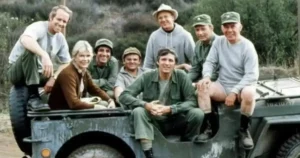
The cast’s reactions weren’t acting—they were genuine. The actors hadn’t been told this would happen until just before filming. McLean Stevenson wanted to leave the show, and producer Larry Gelbart made the bold, brutal choice to kill Henry rather than give him a Hollywood farewell. The message was clear and devastating: in war, good people don’t always get happy endings. Sometimes they just disappear, randomly and senselessly, and life moves forward without them. That scene traumatized a generation of viewers who learned that night that MAS*H played for keeps.
The Bus Passengers
In “Dreams,” Hawkeye has a recurring nightmare about a bus full of wounded soldiers and refugees trying to evade enemy patrols. In his dream, a woman’s chicken won’t stop making noise, threatening to give away their position and get everyone killed. Hawkeye demands she silence the chicken, and she does—by smothering it.
Except it wasn’t a chicken. It was her baby.
This revelation, delivered in the series finale during Hawkeye’s psychiatric evaluation, remains one of the most horrifying moments in television history. The woman had suffocated her own infant to save the rest of the passengers—an impossible choice born from impossible circumstances. Hawkeye, who had pressured her to silence the “chicken,” was forced to live with the knowledge that he’d essentially ordered a mother to kill her child.
This scene violated every unwritten rule about what you could show on television. It wasn’t graphic, but it didn’t need to be. The psychological horror of that moment—the choice no parent should ever face, the guilt Hawkeye would carry forever, the randomness of who lives and who dies in war—hit harder than any battle scene ever could. It showed that war doesn’t just kill bodies; it murders innocence, sanity, and the very humanity of everyone it touches.
The Wounded POW Who Dies Helping Others
In “The Prisoner,” a wounded North Korean prisoner of war is brought to the 4077th. Despite being the enemy, he’s treated with the same care as everyone else. As he recovers, he begins helping the medical staff—translating for other Korean patients, assisting with minor tasks, becoming part of the community.
Just as he’s ready to be transferred to a POW camp, the compound comes under attack. Without hesitation, the North Korean soldier helps evacuate wounded patients to safety, putting himself at risk to save men who were, technically, his enemies. He’s struck by shrapnel during the attack and dies from his wounds.
What made this tragedy so profound was its quiet simplicity. Here was someone who transcended the artificial boundaries of war, who recognized suffering as suffering regardless of which uniform someone wore. His death wasn’t heroic in the traditional sense—there was no dramatic music or slow-motion sacrifice. He simply did what needed doing and paid the ultimate price for his compassion. It was MAS*H at its finest, showing that war forces us to treat human beings as enemies, but our shared humanity refuses to stay buried no matter how hard we try to suppress it.
The Young Soldier Who Lost Everything
In “Sometimes You Hear the Bullet,” a young soldier is brought in with serious wounds. While treating him, Hawkeye discovers the kid lied about his age to enlist—he’s only fifteen years old, desperate to prove himself a man through combat. Hawkeye pulls strings to get him sent home, saving his life.
Minutes later, Hawkeye’s old friend Tommy Gillis, a journalist who had been visiting the camp, is brought into the OR with critical injuries. Despite Hawkeye’s desperate efforts, Tommy dies on the table. Hawkeye completely breaks down, sobbing over the loss of his friend while the young soldier—the one who lied his way into war—gets to live.
This episode gave us one of MAS*H’s most famous lines. When BJ tries to comfort Hawkeye, asking why he’s crying when death is supposed to be just another part of the job, Hawkeye responds through tears: “I’ve watched guys die every day. Why didn’t I ever cry for them?” BJ gently answers: “Because you’re a good doctor, and that’s the only way you could handle it. But I guess the wounds catch up with all of us.”
This moment encapsulated the impossible psychological burden of military medicine—the necessity of emotional distance to function, and the inevitable collapse when that distance fails. It also highlighted war’s cruel randomness: the child soldier who shouldn’t have been there survives, while the adult who volunteered to witness and document the truth dies. There’s no fairness, no cosmic justice, just random tragedy and the people left behind to make sense of it.
Margaret’s Friend Gets Married, Then Dies
In one of the series’ most heartbreaking episodes, Margaret’s close friend arrives at the 4077th to get married. Despite the war surrounding them, it’s a moment of genuine joy and hope—two people in love refusing to let circumstances steal their happiness. The ceremony is beautiful, the celebration genuine, and for a brief moment, the war seems far away.
Less than twenty-four hours later, the bride is killed by enemy fire.
The episode doesn’t give viewers time to process the joy before delivering the tragedy. There’s no warning, no dramatic foreshadowing—just like in actual war, death arrives without courtesy or consideration for our emotional preparedness. Margaret, already struggling with her own failed marriage and feelings of isolation, is forced to confront the absolute cruelty of war: it doesn’t care about your dreams, your happiness, or your desperate attempts to build something beautiful amid the chaos.
What elevated this beyond simple melodrama was Loretta Swit’s performance as Margaret grapples with survivor’s guilt and existential rage. Why did her friend die while she lived? What’s the point of love, hope, or trying to build a future when random violence can erase everything in seconds? These questions hung heavy over the episode with no easy answers provided—just the brutal acknowledgment that sometimes tragedy is senseless, and we survive it without understanding why.
The Soldier Who Wanted to Keep His Leg
In “Quo Vadis, Captain Chandler,” a bomber pilot crashes and sustains severe leg injuries. The medical staff determines amputation is necessary to save his life, but the pilot refuses. He’s terrified that losing his leg means losing everything—his career, his identity, his worth as a man.
Hawkeye and the team try everything to change his mind, explaining that he’ll die without the surgery. The pilot remains adamant: he’d rather die complete than live as “half a man.” Eventually, they honor his wishes, and viewers watch him slip away, his choice respected even as it breaks everyone’s heart.
This episode tackled disability, masculinity, and bodily autonomy with remarkable sensitivity for 1970s television. It didn’t present a clear villain or an obvious right answer. Instead, it showed the psychological trauma of severe injury—how our identities become intertwined with our physical bodies, and how war destroys not just flesh but the very sense of self. The medical staff’s anguish at watching someone die from a treatable injury, purely because the treatment was psychologically unbearable to the patient, highlighted yet another way war devastates everyone it touches.
The Christmas Episode Ceasefire That Wasn’t
In “Death Takes a Holiday,” the 4077th staff desperately tries to keep critically wounded patients alive through Christmas Day. If they can just hold on until December 26th, their deaths won’t be recorded as happening on Christmas—a small mercy for the families who would otherwise associate that holiday with loss forever.
The medical team works frantically, employing every trick and technique to keep failing bodies alive just a few more hours. Some make it. Others don’t. The episode ends with the staff exhausted, having fought to give strangers’ families the gift of one unruined Christmas, knowing they’ll fail to save everyone but trying anyway.
This episode’s tragedy wasn’t a single shocking death but rather the grinding, relentless nature of wartime medicine—the way death becomes a statistics game, where success means barely postponing the inevitable. It showed medical professionals warping their own ethics, playing God with timing to ease distant strangers’ grief, all while processing their own trauma about the constant, unending tide of casualties. There’s no victory, no triumph—just exhausted people doing what little they can to inject tiny moments of mercy into an inherently merciless situation.
Why These Moments Still Matter
These seven tragic moments weren’t just emotional manipulation or cheap shock value. They were MAS*H fulfilling its true purpose: forcing comfortable Americans watching from their living rooms to confront the authentic cost of war. Not the sanitized, glorified version sold by recruitment posters and action movies, but the real thing—random, senseless, psychologically devastating, and utterly indifferent to human dreams and dignity.
Decades later, these scenes remain powerful because the truths they illustrated are timeless. War still destroys innocence. It still forces impossible choices. It still kills randomly and without meaning. And those who survive still carry wounds that never fully heal. MAS*H refused to let us forget that, episode after episode, joke after tragedy after devastating truth.