MAS*H didn’t just happen—it was fought for, innovated over, and created through a combination of artistic vision, technical ingenuity, and sheer stubbornness. The show that changed television forever emerged from production battles, creative compromises, and brilliant problem-solving that transformed limitations into strengths. These five behind-the-scenes facts reveal the remarkable circumstances that shaped one of television’s greatest achievements and show how the best art often emerges from the most challenging conditions.
The Laugh Track Battle That Changed Television Comedy
One of MAS*H’s most significant production battles involved something viewers take for granted—the laugh track. Creator Larry Gelbart and the production team fought desperately to eliminate it entirely, arguing that canned laughter undermined the show’s dramatic moments and treated audiences like they couldn’t recognize humor without prompting. CBS executives refused, insisting that audience research showed viewers expected laugh tracks in comedies and felt uncomfortable without them.
The compromise that emerged changed television history. Gelbart negotiated the right to remove the laugh track from operating room scenes, arguing that laughing at medical procedures treating war casualties was morally reprehensible. CBS reluctantly agreed, creating an unprecedented hybrid approach where comedy alternated between laugh-tracked and naturalistic scenes. This inconsistency actually heightened the show’s impact—the sudden silence in the operating room made those scenes feel more serious and real by contrast.
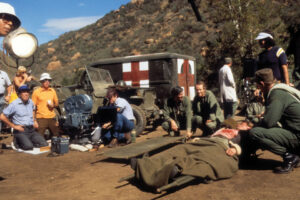
What many viewers don’t realize is how revolutionary this partial victory was. Before MASH, sitcoms were almost universally laugh-tracked, with networks believing audiences needed guidance to know when something was funny. MASH proved that comedy could work without artificial enhancement, paving the way for laugh-track-free shows that followed. The production team’s willingness to fight this battle, even though they didn’t win completely, demonstrated their commitment to treating both the material and audience with respect.
The technical execution of this compromise created additional challenges. Sound editors had to carefully determine where laugh tracks should begin and end, creating smooth transitions between tracked and untracked scenes. Some episodes feature jarring shifts where laughter abruptly cuts off when the scene moves to the operating room, an awkwardness that actually serves the show’s purpose by emphasizing the tonal contrast. This “imperfect” solution became an artistic choice that enhanced rather than diminished the final product.
The Outdoor Set Became an Actual Historical Landmark
MAS*H’s outdoor compound set, constructed at the Fox Ranch in Malibu Creek State Park, represents one of television’s most elaborate and enduring production designs. Built for the 1970 feature film and repurposed for the series, the set required constant maintenance and periodic reconstruction throughout the show’s eleven-year run. What makes this set remarkable is its authenticity—production designer Walter M. Jefferies researched actual Mobile Army Surgical Hospital layouts to create an accurate representation of Korean War medical facilities.
The set’s location created both opportunities and challenges. The California landscape reasonably approximated Korean terrain, but weather conditions meant production shut down during rain or extreme heat. The remote location—accessible only by rough roads—required transporting equipment, cast, and crew to an isolated area without easy access to facilities or services. This isolation actually enhanced performances, as actors genuinely felt removed from civilization in ways that studio sets couldn’t replicate.
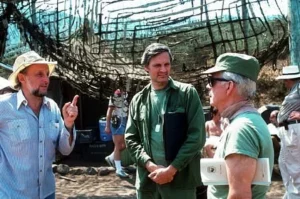
Over eleven years, the set weathered, creating unintended authenticity. The buildings, originally constructed as temporary structures, began genuinely deteriorating, making them look increasingly like actual war-era facilities. Rather than constantly repainting and repairing, the production team embraced this aging, allowing the set to develop natural wear that added visual realism. By the series’ end, the structures looked appropriately war-worn without requiring artificial distressing.
After MASH ended, the set remained standing and became a tourist attraction. Fans could visit the actual location where the show was filmed, walking through the compound and recognizing specific spots from favorite episodes. However, a 1982 wildfire destroyed most of the structures, leaving only a few pieces of wreckage. Today, the site is marked with a small sign, and visitors can still see remnants of the set that housed television’s most beloved medical unit. This transformation from working set to historical landmark reflects MASH’s cultural impact—it transcended being merely a television show to become a piece of shared cultural memory.
Multiple Actors Had Actual Medical Training
What gave MAS*H’s operating room scenes their remarkable authenticity wasn’t just good acting—several cast members had genuine medical training that informed their performances. Alan Alda’s father, Robert Alda, was friends with several surgeons who coached Alan on proper surgical technique, hand positioning, and the physical rhythm of operating. Alda took this coaching so seriously that medical professionals who watched the show commented on his technically accurate movements.
Mike Farrell, who played B.J. Hunnicutt, went even further. He requested training from real surgeons to understand not just the motions but the mindset of performing surgery. He learned to identify surgical instruments by touch without looking, replicate proper suturing technique, and move around an operating table without breaking sterile fields. This dedication meant that wide shots of operating room scenes could show actual surgical procedures without requiring constant cutting to close-ups and hand doubles.
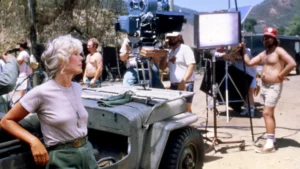
The most remarkable medical authenticity came from the show’s technical advisors—actual Korean War MASH surgeons who consulted on procedures, reviewed scripts for accuracy, and sometimes performed the actual surgical work shown on screen. In close-up shots showing detailed procedures, these consultants’ hands often replaced actors’ hands, performing real surgical techniques on realistic medical dummies designed to replicate human tissue response.
This commitment to medical authenticity served multiple purposes. It respected actual MASH personnel by accurately depicting their work rather than relying on Hollywood stereotypes. It educated viewers about genuine surgical procedures and medical challenges in ways that increased appreciation for field medicine. Most importantly, it grounded the show’s comedy in authentic reality—the humor never came from mocking or trivializing the medical work, which remained consistently professional and realistic throughout.
The Show Was Filmed Like a Movie, Not a Sitcom
MASH revolutionized television production by rejecting sitcom conventions in favor of single-camera filmmaking more common in cinema. Traditional sitcoms used multi-camera setups with theatrical staging—actors performed toward the cameras in brightly lit sets designed to be filmed from multiple angles simultaneously. MASH instead used single cameras, natural lighting, and cinematic composition that required filming scenes multiple times from different angles.
This approach dramatically increased production time and cost. Where multi-camera sitcoms could film an episode in a few days, MAS*H required week-long shoots with extensive setup time for each shot. Lighting had to be adjusted for every camera position, actors had to maintain continuity across multiple takes, and editing became far more complex with hours of footage requiring assembly into coherent episodes.
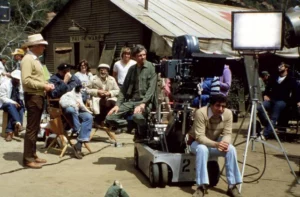
The visual payoff justified the additional effort. MAS*H looked completely different from other sitcoms—it had depth, shadow, and visual complexity that made it feel cinematic rather than theatrical. Exterior scenes particularly benefited from natural lighting and real locations that gave the show unprecedented realism. The cinematography could tell stories through visual composition, using framing, focus, and camera movement to convey emotion and meaning beyond dialogue.
This production approach also affected performances. Without a studio audience or multi-camera setup, actors performed more naturalistically, speaking quietly and using subtle expressions that would be lost in theatrical sitcom staging. This intimacy drew viewers into the story in ways that traditional sitcoms couldn’t match. Directors could use close-ups to capture nuanced reactions and emotional beats that revealed character depth impossible in wide master shots designed to show multiple actors simultaneously.
The Writers Room Included Actual Korean War Veterans
MAS*H’s writing achieved remarkable authenticity partly because the writers room included people who actually experienced the Korean War. Several writing staff members were veterans who served in various capacities during the conflict, bringing firsthand knowledge of military culture, medical procedures, and the psychological reality of war. Their experiences informed storylines, dialogue, and details that created texture impossible to achieve through research alone.
These veteran writers contributed more than just accuracy—they provided emotional truth. They understood the specific humor that emerges in war zones, the gallows comedy that helps people process horror, and the particular absurdities that arise when military bureaucracy meets life-and-death situations. Their stories of actual experiences became the basis for many episodes, ensuring that even the most outrageous plots were grounded in things that really happened.
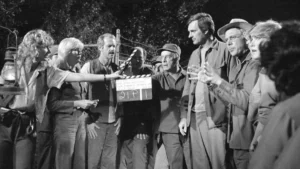
The presence of veteran writers also kept the show honest about war’s reality. When dramatic storylines risked becoming manipulative or when comedy threatened to trivialize serious subjects, these writers provided perspective that balanced entertainment with respect for actual experience. They served as conscience and reality check, ensuring the show never exploited war for cheap emotion or easy laughs.
This commitment to authenticity extended beyond veterans to include medical consultants, cultural advisors, and historical researchers who reviewed scripts for accuracy. The production maintained relationships with Korean War veterans’ organizations, seeking feedback and input throughout the show’s run. This collaborative approach transformed MAS*H from entertainment into a form of historical documentation that preserved and honored actual experiences while making them accessible to audiences who never experienced war directly.
Why These Production Details Matter
Understanding how MAS*H was made deepens appreciation for what was achieved. The show’s excellence wasn’t accidental—it emerged from countless deliberate choices, hard-fought battles, and unwavering commitment to quality over convenience. Every technical innovation, every authenticity detail, and every production challenge overcome contributed to creating something that transcended typical television to become genuine art.
These behind-the-scenes stories also reveal that great art often requires fighting for your vision against systems that prioritize safety and convention. MAS*H succeeded because its creators cared enough to fight battles over laugh tracks, invest extra time in cinematic filming, and maintain authenticity even when it complicated production. Their refusal to compromise on what mattered created a show that remains relevant decades later, proving that artistic integrity isn’t just noble—it’s practically effective in creating work that endures.