On February 28, 1983, 125 million Americans stopped everything they were doing to watch the same television program. No sporting event, no presidential address, no news emergency—just the final episode of MAS*H. To put that in perspective, nearly half of all Americans tuned in simultaneously, creating a shared cultural moment that may never be replicated in our fragmented media landscape. But what transformed a sitcom about a mobile army surgical hospital during the Korean War into a phenomenon that transcended television itself? The answer lies deeper than good writing or talented actors—it touches something fundamental about how we process tragedy, find humor in darkness, and connect with our shared humanity.
Reason One: MAS*H Shattered the Comedy-Drama Barrier
Before MASH, television existed in rigidly defined categories. Comedies had laugh tracks, predictable setups, and happy endings. Dramas were serious, somber, and definitively not funny. MASH arrived like a grenade tossed into this orderly system, exploding all the rules and creating something entirely new—a show that could make you laugh until your sides hurt in one scene, then leave you sobbing three minutes later.
The genius of MAS*H lay in its understanding that this tonal whiplash wasn’t just a stylistic choice—it was the most honest representation of how people actually survive trauma. Hawkeye Pierce’s constant jokes weren’t comic relief; they were a survival mechanism. The pranks, the parties, the absurdist humor that filled the Swamp weren’t distractions from the horror of war—they were essential tools for maintaining sanity while wading through it.
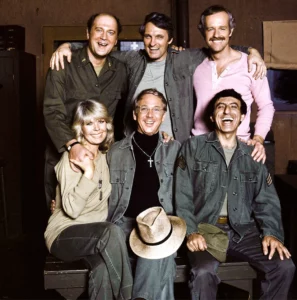
This revolutionary approach influenced virtually every prestige drama that followed. Shows like The Sopranos, Breaking Bad, and ER all owe a debt to MASH for proving that audiences were sophisticated enough to handle tonal complexity. We didn’t need to be told how to feel with a laugh track or melodramatic music. MASH trusted viewers to navigate the emotional landscape themselves, and in doing so, created a more mature form of television storytelling.
The show’s willingness to eliminate the laugh track entirely in operating room scenes was particularly bold. Producer Larry Gelbart fought the network on this decision, arguing that canned laughter over scenes of wounded soldiers was obscene. He won that battle, and those silent surgical sequences became some of the most powerful moments in television history—proof that comedy and tragedy weren’t opposites but dance partners in the human experience.
Reason Two: It Spoke Truth to Power During a Divided Era
MAS*H premiered in 1972, set during the Korean War but speaking directly to a nation torn apart by Vietnam. The show couldn’t explicitly criticize the ongoing war—network censors would never allow it—but the brilliance of using Korea as a proxy war allowed the writers to say everything they needed to say while maintaining plausible deniability.
Every episode that highlighted the absurdity of military bureaucracy, the disconnect between generals and ground troops, or the psychological cost of endless conflict resonated with contemporary audiences watching their friends and family members return from Southeast Asia. When Hawkeye railed against the senselessness of war, viewers heard their own frustrations voiced by a beloved character on primetime television.
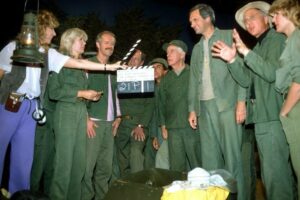
The show gave voice to a generation’s disillusionment without being preachy or heavy-handed. It didn’t present simple answers or paint soldiers as either heroes or villains. Instead, it showed them as complicated human beings doing their best in impossible circumstances—a nuanced perspective that felt revolutionary in an era of polarized public discourse.
What made this even more remarkable was MAS*H’s ability to appeal across political divides. Conservative viewers could appreciate the show’s respect for the medical staff’s dedication and sacrifice. Liberal viewers connected with its anti-war messaging. Both groups laughed at the same jokes and cried at the same tragedies, creating rare common ground during a fractured period in American history.
Reason Three: Characters Who Evolved Like Real People
Most sitcom characters in the 1970s were static archetypes who returned to baseline by episode’s end. MAS*H dared to let its characters grow, change, and carry emotional scars across seasons. This was groundbreaking serialized storytelling disguised as episodic television.
Consider Margaret Houlihan’s transformation from “Hot Lips”—a one-dimensional antagonist and punchline—into one of television’s most fully realized female characters. Her failed marriage, her struggle for respect in a male-dominated military, her gradual softening without losing her strength—this was character development that television audiences had never seen in a comedy before.
Or watch Hawkeye across 11 seasons. He begins as a wise-cracking ladies’ man who seems almost immune to the horror around him. By the series finale, we see a man so psychologically damaged by years of war that he’s suffered a complete mental breakdown. That final episode, where Hawkeye recovers a repressed memory of a traumatic incident, was devastatingly honest about PTSD decades before that term entered mainstream consciousness.
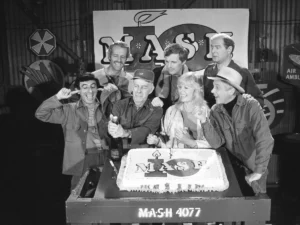
The show wasn’t afraid to lose beloved characters either. When McLean Stevenson wanted to leave, they killed off Henry Blake in one of television’s most shocking moments. That helicopter crash sent a clear message: this show plays for keeps. In war, people don’t get happy endings or farewell tours. Sometimes they’re just gone, and life moves forward anyway.
This commitment to authentic character development created unprecedented emotional investment. Viewers didn’t just watch MAS*H—they lived with these characters for over a decade. We attended their weddings, mourned their losses, celebrated their small victories. When the show finally ended, it felt like saying goodbye to old friends, which explains why 125 million people showed up for that farewell.
The Lasting Legacy
MASH proved that television could be art, that comedy could tackle serious subjects, and that audiences were hungry for programming that respected their intelligence and emotional complexity. It paved the way for everything from Cheers to The West Wing, from Scrubs to This Is Us. The modern “dramedy” genre exists because MASH demonstrated its viability and power.
More than four decades after its finale, MAS*H remains relevant because the questions it asked are timeless. How do we maintain our humanity in inhumane situations? How do we find laughter when surrounded by tragedy? How do we connect with others across differences of rank, ideology, and experience? These aren’t questions specific to the Korean War or even war itself—they’re fundamental queries about the human condition.
That’s why MASH became more than a television show. It became a cultural touchstone, a shared reference point, and proof that popular entertainment could also be meaningful, challenging, and transformative. In an era where we’re constantly told that media is more fragmented than ever, MASH stands as a reminder of when 125 million people could share a single moment—and be changed by it together.